

Top Virtual Training Technologies Transforming Military Readiness
Introduction: The Strategic Shift toward Digital Military Training
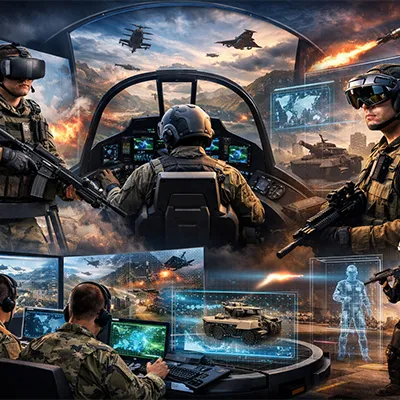
The military forces of the modern world are engaged in the conditions of asymmetric warfare, rapid development of technologies, and more sophisticated operating conditions. Thought to be invaluable, traditional live-field training is no longer ready to go on its own to prepare soldiers to multidomain operations over land, seas, air, cyber, and space. The increasing operation expenses, safety issues, environmental limitations and the demand to gain the skill more quickly has enhanced the uptake of virtual military training technologies within the defence organizations of the globe.
Military training systems can now be considered a vital force multiplier as armed forces can simulate high-risk situations, train coordinated operations, and test their decision-making under pressure without use of physical resources. With the increase in military modernization programs around the globe, defense simulation and digital training solutions to defense are emerging to be pillars of military readiness.
Understanding Virtual Military Training Technologies in a Defense Context
Virtual military training technologies can be defined as digitally empowered tools that imitate the real-world combat, operational, and tactical experience based on simulation software, artificial intelligence, extended reality, and information-based analytics. These technologies enable the staff to train over and over again under realistic conditions at a low cost risk, and logistical complexity.
In contrast to the old classroom based or live exercises, virtual military training systems have provided the ability of persistent learning by enabling the scenarios to be altered on the fly. Military simulation programs are able to emulate variables of a battlefield including terrain, weather, enemy behavior, equipment failures, and the presence of civilians which provide some flexibility that cannot be achieved through physical drills.
Military Simulation Software as the Core of Defense Training Transformation
The advanced defense training technologies depend on military simulator software. These systems combine physics engines, behavioral modeling, geospatial intelligence with command and control logic to create realistic operation situations. Individual training of soldiers up to large-scale combined exercise drills are all assisted using simulation software at all levels of military preparedness.
Simulation platforms in defense are becoming more interoperable and land forces, naval combatants, air squadrons and cyber teams are able to train in a single virtual environment. This capability of the joint force is needed because the contemporary war depends on the coordinated cross-domain activities.
Industry Definition: Military Simulation Software
A military simulation software is an online platform that has the capability of simulating combat environments, operating systems, and human behavior to train, rehearse missions and strategize in military defense organizations.
Immersive Virtual Training Systems for Modern Armed Forces
One characteristic of the next-generation virtual military training technologies is immersion. Research in virtual reality, augmented reality, and mixed reality has facilitated highly realistic virtual training systems of the contemporary armed forces such that the trainees can feel reality when simulation takes place.
VR-based defense training technologies put the soldiers in the fully simulated battlefields where they can train in the movements, the handling of the weapon, and the decision-making process. AR overlays augment the real world training by superimposing mission information, the position of the enemy, or the health of equipment into the view of the trainee. Mixed reality systems provide a combination of both physical and digital worlds, making it possible to create hybrid training, whereby live equipment is used with virtual enemies.
These virtual military training systems improve the muscle memory, situational awareness and cognitive resilience of the operational preparedness.
High-Future Simulation Technology of Defense Training and Mission Rehearsal
Advanced simulation technologies are not limited to visual realism. The artificial intelligence is at the heart of the contemporary defense simulation because it makes possible adaptive behaviour of the enemy, dynamic scenario development, and automated evaluation of performance.
Artificial intelligence based military simulation programs can evaluate trainee actions on real time, change enemy tactics or environmental condition according to the skill level. This builds a learning environment which will develop with the trainee so that it becomes a constant challenge and progression of skills. Defense training technologies also use machine learning algorithms to detect performance gaps, forecast levels of readiness and suggest individual training paths.
Mission rehearsal by simulation has proven to be vital most particularly to the special operations, air defense and naval task groups where accuracy and coordination are not bargains.
Digital Training Solutions for Defense Organizations
Defense digital training solutions no longer focus on immersive simulation but expand to include cloud based learning systems, data analytics dashboards, and networked training systems. These solutions allow the defense organizations to streamline training content, standardize training, and provide the performance tracking across the unit and location.
Virtual military training systems that are Cloud-enabled enable the geographically separated forces to engage in common simulations that facilitate the training of a coalition and multinational interoperability. Firewall digital environments provide the benefit of keeping sensitive data of defense simulation safe and still allow scalable implementation.
To defense contractors and system integrators, the defense digital training solutions are a fast growing market segment that is consistent with the long term military modernization plans.
Table: Key Virtual Training Technologies Shaping Military Readiness
| Technology Domain | Primary Training Application | Strategic Impact |
| Virtual Reality Simulation | Individual and squad-level combat training | Improves situational awareness and reaction time |
| AI-Driven Defense Simulation | Adaptive enemy modeling and decision training | Enhances tactical realism and cognitive readiness |
| Networked Simulation Platforms | Joint and coalition force exercises | Strengthens interoperability and coordination |
| Digital Twin Environments | Equipment and system training | Reduces equipment downtime and training costs |
Defense Simulation in Multidomain and Hybrid Warfare Training
Modern conflict has become very complex and as such, the role of defense simulation in the preparation of multidomain warfare has been increased. Military training technologies have been virtualized, adding to the conventional combat simulation the cyber operations, electronic warfare, space assets and information warfare.
Military simulation programs are the ones that allow commanders and operators to comprehend how the actions in one domain will influence the results in the other. As an example, a simulated cyberattack can come in the way of communications of a virtual ground operation, compelling trainees to improvise strategies on the fly. Such a comprehensive strategy equips armies with hybrid threats that combine conventional and unconventional strategies.
Top Virtual Training Technologies for Military Readiness Programs
Best virtual training technologies in military preparedness have a few common attributes: scalability, realism, adaptability and interoperability. These systems are developed to develop with doctrine, equipments and threat landscape.
Most advanced defense training technologies have the ability to incorporate real-world sensor, satellite imagery and operational intelligence into a simulated environment. This makes virtual military training systems be in line with real conditions of missions. The rapid updating nature enables armed forces to train on emerging threats without necessarily having to wait to be provided with new physical infrastructure.
Industry Checklist: Evaluating Virtual Military Training Systems
Military training systems that are reviewed by defense procurement teams normally include realism, interoperability, cybersecurity resiliency, scalability and life-cycle cost. Interoperability with the pre-existing command-and-control systems and compatibility with the allied training platforms are also important factors.
The Business Case for Defense Simulation and Virtual Training Investments
Virtual military training technologies have strong benefits on the return-on-investments. Defense simulation saves fuel, equipment wear, or ammunition waste, and staff risk created by live exercise. The training cycles are reduced, repeatable and data-driven.
In the case of defense technology providers, defense simulation software and digital training solutions are long-term sources of revenue in terms of software updates, system upgrades and data service. Modular and software-based defense training technologies that do not require hardware upgrades are increasingly popular with governments.
Future Outlook: The Evolution of Virtual Military Training Technologies
The future of military training technology being virtual is more convergence of simulation, operational systems, and real time data. The use of artificial intelligence, 5G connectivity, and edge computing will also make the defense simulation environment more realistic and responsive.
Biometric feedback, cognitive modeling of stress, and autonomous agent behavior will more likely be considered in immersive virtual training systems designed to train modern armed forces. These advances will enable the training systems to not just gauge technical competence, but also, psychological preparedness in the field of combat like situations.
FAQ Summary: Virtual Training Technologies in Defense
Virtual technologies in military training enhance preparedness through realistic, repeatable and risk-free training situations that respond to changing threats. The use of military simulation software is unique in contrast to the conventional training aids since it does not provide fixed drills but dynamic, AI-controlled environments. With the help of defense simulation, joint operations may be supported through the ability of engagement of various force domains within mutual virtual spaces. Defense training solutions reduce the long-term costs and enhance the frequency of training and data-driven performance evaluation.
Conclusion: Redefining Military Readiness through Virtual Training
Military training technologies are virtual training technologies that moved through the experimental training tools to mission-critical elements of the defense readiness strategies. Through integration of military simulation software, immersive virtual training systems and innovative digital training systems in defense, armed forces can be equipped better to face the realities of the modern warfare.
The modern simulation technologies in defense training are also going to be a strategic need as long as defense organizations focus on agility, interoperability, and technological superiority. The evolution of the military readiness ceases to occur on physical training grounds; it emerged in the incredibly advanced virtual space to form the future of military defense in the whole world.
 Our Services
 Media Pack Download
 Newsletters
 Industrial Events