

Next-Generation Tactical Training with Immersive VR and AR Simulation Systems
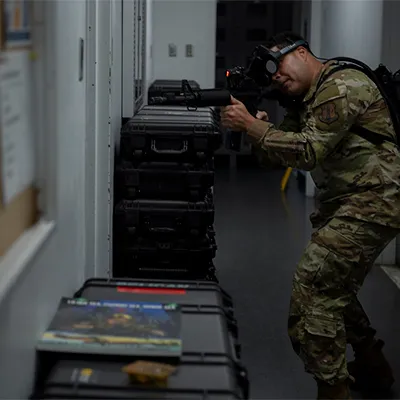
In the contemporary defense forces, the question of whether the digital training environment is needed or not is no longer a question to be asked. The question that determines the procurement decisions being made today is how the complexities of battlefields can be simulated using immersive technologies without putting the personnel at actual risk. With the development of the operational theaters, VR tactical training and AR tactical training are transforming the way soldiers prepare, adapt, and react. In place of what was formerly confined to physical training and classroom learning, it has grown into highly immersive, information-dense simulated environments resembling actual combat scenarios.
Virtual reality and augmented reality are not just technological modifications of tactical training. It is an essential change in the way preparedness, decision-making, and situational awareness are developed within military organizations.
Why Traditional Tactical Training Is No Longer Enough
The traditional field drills are necessary, but they are associated with inevitable limitations. Uneven ground, weather dependence, logistical burdens, hazards, and a limited variety of scenarios tend to restrict the ability of forces to train in uncommon and high-impact circumstances. It is at this point that immersive training of defense can start showing a return on investment.
Through the incorporation of military virtual reality training within tactical curricula, the armed forces will be able to practice high-risk conditions many times without causing wear and tear to gear and soldiers. The kind of complex urban warfare, asymmetric threats, cross-domain, and joint-force coordination can be replicated with startling accuracy. As compared to a static simulation, a contemporary virtual combat training system is dynamic and adjusts to the actions of the trainee, thus generating uncertainty, which resembles an actual engagement.
This trend of increased use of VR to train tactical training is an indication of an industry response to the fact that repetition, realism, and fast feedback loops are essential to operational preparedness.
The Evolution of Military Virtual Reality Training
The initial military virtual reality training was based on the trainee’s marksmanship and simple movement exercises. The current platforms have now become networked artificial intelligence-based ecosystems comprising command-and-control logic, environmental physics, and cognitive stress modeling.
Of specific interest with next-generation virtual combat training systems is that they are scalable. Soldiers, individually, or in small groups (squeezing squads), in platoons, and in a combined task force can be trained concurrently in a common virtual space. This connectivity facilitates coordinated decision-making exercises that were previously very hard to coordinate physically.
With the maturity of VR tactical training, it is now being applied as a skill acquisition and also as a means of performance evaluation. Reaction times, patterns of communication, and tactical decisions can be analyzed at a level never before achievable by the commanders.
AR Tactical Training and the Rise of Mixed-Reality Readiness
Whereas VR provides soldiers with entirely virtual training environments, AR tactical training improves the real-world training by displaying digital intelligence on the physical environment. The convergence is transforming the manner in which live training exercise is carried out at a very rapid rate.
Physical exercises become contextual with the help of augmented reality for soldiers. Digital adversaries, mission goals, warning signs, and traffic signs could be directly visualized in the field of vision of a trainee. This enables the forces to do live-fire or maneuver operations, and at the same time interact with simulated variables.
Use of augmented reality in providing situational awareness in training is especially beneficial in an environment it may not be practical to implement the entire VR. Soldiers still exist on the physical plane, but they are much more perceptive, just like in contemporary sensor-driven warfare.
Tactical Training with VR and AR: A Converged Approach
VR and AR are not viewed as independent tools anymore because of the most advanced defense training programs. On the contrary, VR and AR-based tactical training is becoming a combined approach that harmonizes virtual simulation and real-life settings.
A soldier could start a task assignment simulation in a complete virtual sphere using VR tactical training, finding out the terrain plans, the formations of threats, and the rules of engagement. The same rehearsal may then shift to a live drill, in which AR tactical training can be introduced, in which the virtual components confirm muscle memory, as well as decision-making under the pressure of the physical action.
This overlap is re-conceptualizing immersive training applied to defense to make it more contextual and in-service. Instead of separate training events, forces undergo a continuous learning cycle, which changes as operational requirements change.
Augmented Reality for Soldiers: Beyond Visualization
Augmented reality among soldiers is not so strong in visual overlays, but the context in which data is provided. Environmental intelligence, biometric feedback, and real-time mission parameters can be displayed in an intuitive way that minimizes cognitive overload.
In training situations, situational-awareness training using augmented reality facilitates the processing of information in a faster and more precise way by the soldiers. The threat identification, friend-foe recognition, and navigation cues are provided in a manner that reflects natural perception.
With the advanced AR tactical training systems, there is a growing use of simulating electronic warfare conditions, compromised communications, and disputed GPS locations. This equips soldiers with situations in whereby the conventional information channels can be compromised.
AR-Assisted Mission Rehearsal for Armed Forces
AR-supported mission rehearsal of military personnel is one of the most revolutionary ways to use immersive technology. AR-based rehearsals provide units with a three-dimensional view of the real terrain (as opposed to the two-dimensional map-based planning), which is relevant particularly in dynamic missions.
Through augmented reality in soldiers, commanders are able to take troops through routes, objectives, and even contingencies before deployment. This spatial perception enhances the coordination and less uncertainty when operating in real time.
The usefulness of AR-based mission rehearsal in the armed forces is particularly evident during urban operations, humanitarian missions, and inter-unit and inter-agency exercises. Similarity of associated visuals increases correlativeness and reduces misunderstanding.
Market Momentum and Defense Investment Trends
The defense industry all over the world is experiencing a prolonged defense investment in immersive training, which is motivated by the need to operate and the maturity of technology. Virtual combat training systems that are capable of being digitally updated as opposed to being physically rebuilt are becoming the procuring strategy in procurement strategy.
A simplified perspective on how the adoption of immersive training is transforming across the critical defense spheres is shown below:
| Training Domain | Role of VR Tactical Training | Role of AR Tactical Training |
| Infantry Readiness | High-fidelity combat simulation and stress conditioning | Live exercise augmentation and threat visualization |
| Urban Warfare | Fully simulated dense environments | Real-world terrain with digital overlays |
| Joint Operations | Multi-user virtual coordination | Shared situational awareness across units |
| Mission Rehearsal | Scenario replication and iteration | Spatial planning and route visualization |
This increased dependence on virtual reality training based on military training is symptomatic of a more general transition to data-driven models of readiness. The results of training are no longer measured by the completion criteria, but by quantifiable performance metrics that are reported in the course of immersive systems.
Virtual Combat Training Systems and Cognitive Readiness
Outside physical capabilities, virtual combat training systems are more frequently aimed at cognitive resilience. Modern VR tactical training environments are integrated with stress inoculation, ethical decision-making, and quick assessment of threats.
These systems provide time pressure, unclear information, and unknown variables to the psychological pressure trainee. Soldiers are trained to be effective in situations where the information is incomplete or even contrary, and this is coupled with augmented reality to provide situational awareness in training.
This focus on cognitive preparedness is consistent with the facts of contemporary warfare, where decisions have to be made within a short period, and the consequences are instant.
The Future of Tactical Training with VR and AR
With the further development of artificial intelligence, spatial computing, and wearable hardware, the process of tactical training based on VR and AR will become more adaptive. Individual and unit-level performance will be considered to develop a training environment in real-time.
The future of immersive training of defense platforms will incorporate live operational data, which will allow ongoing feedback with training and deployment. Field lessons can be quickly converted into new VR training scenarios of tactical training and AR training tactical training overlay.
The increased complexity of AR-based mission rehearsal by military forces implies that immersive technologies will be the key component not only in preparation, but also in planning and coordination.
A Strategic Imperative, Not a Technological Experiment
What comes out strongly with trends in the industry is that military virtual reality training and augmented reality for soldiers are no longer an experimental addition. These are emerging as strategic missions of defence organizations that aim to be agile, efficient, and resilient.
Through the adoption of virtual combat training systems, the military would be able to train more often, more safely, and smarter. When they invest in the augmented reality of situational awareness during training, they are increasing real-world preparedness and not realistic.
Finally, VR and AR do not replace the traditional training methods at all, but help to open new possibilities in tactical training. The future armies (and armies) that make the most out of immersive technologies will be the ones that pose the right questions, challenge harder and more quickly than ever before.
With the next-generation training systems being considered by the defense leaders, one question keeps being asked: in the world of threats that keep changing fast, can any force afford not to train immersively?
 Our Services
 Media Pack Download
 Newsletters
 Industrial Events