

The Evolution of Defense: How Advanced Tech Is Reinventing Security

Introduction:
The rapid development of threats throughout this modern age makes it essential to possess advanced military technology than ever before. Military establishments now use next-generation technologies based on artificial intelligence and quantum computing as well as blockchain security because traditional defense strategies have become obsolete. National security heavily depends on cybersecurity development which now matches the importance of traditional physical combat in modern battlefields.
The future of defense receives its shape through innovative technologies which develop autonomous defense drones as well as smart surveillance systems and additional advanced systems.
The Rise of Advanced Military Technology
Our current era excludes conventional foot troops and fighter aircraft from war activities. By implementing IoT technologies into security frameworks military forces gain better ways to monitor their environments while improving their immediate responses. Defense systems have undergone fundamental changes through the deployment of modern sensors along with analytics systems and predictive intelligence.
Our current era excludes conventional foot troops and fighter aircraft from war activities. By implementing IoT technologies into security frameworks military forces gain better ways to monitor their environments while improving their immediate responses. Defense systems have undergone fundamental changes through the deployment of modern sensors along with analytics systems and predictive intelligence.
The development of hypersonic weapons represents an unprecedented accomplishment because it allows missiles to surpass Mach 5 in speed thus making existing missile defense systems useless. Different nations struggle to develop hypersonic weapons at the same time they focus on achieving increased precision and stealth capabilities during this new arms competition.
| Technology | Key Benefit |
| Quantum computing in defense | Unbreakable encryption, enhanced cryptography |
| Blockchain for security | Tamper-proof communication, secure data transmission |
| Autonomous defense drones | Reduced human casualties, precision strikes |
| Satellite-based surveillance | Real-time tracking of threats |
Cybersecurity Advancements: The Digital Frontline

Attacks conducted through cyber methods now have equal danger potential to physical assaults. Worldwide governments together with organizations maintain large-scale funding of cyber warfare capabilities to protect themselves from hacking attacks and digital espionage and sabotage. The emerging use of quantum technology in military defense will create encryption advancements that produce uncrackable cyber-security standards for vital information.
Security through blockchain technology has become a strong defense mechanism that ensures classified information security through complete data integrity while blocking unauthorized access. National defense status has been achieved by cybersecurity because cyber warfare continues to grow stronger.
5G Impact on Security

The deployment of 5G networks creates dual benefits together with security risks for defense organizations. The improved and secure communication capabilities which 5G provides come with newly discovered security weaknesses.
The main requirement for smart surveillance systems is real-time data transmission which becomes vulnerable to critical intelligence compromises through breaches in 5G networks. Defense security forces maintain strict protocols to protect their 5G infrastructure from cyberattacks.
Autonomous Defense Drones and Robotic Military Applications
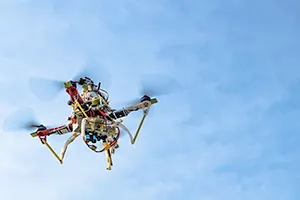
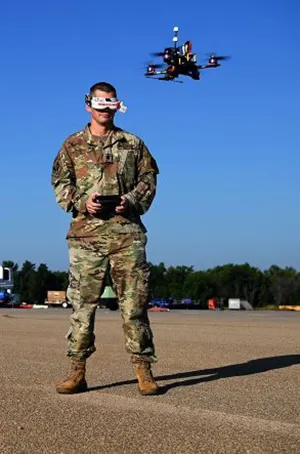
The military now operates with higher than ever levels of automation technology. Defense drones driven by autonomous systems are modernizing the tactics of reconnaissance as well as targeting and combat procedures. The drones use AI technologies to autonomously fight threats independently from human control.
Robotic military technologies now operate in dangerous areas to perform bomb clearance operations and conduct surveillance functions and participate in direct combat troops. Defense operations at present and into the future will improve their speed and efficiency because AI converges with robotics along with machine learning applications.
Smart Surveillance Systems and Biometric Security Solutions

Urban security together with border protection witness fundamental changes because smart surveillance systems have arrived. System detection capabilities undergo improvement because of AI-powered cameras which combine with facial recognition and behavior analytics services.
Fingerprint scanning and retina recognition and voice authentication together form biometric security solutions which defense facilities use to enhance their access control capabilities. The applied technological solutions both improve security capabilities and remove weaknesses that exist in traditional authentication practices.
Smart Border Control Systems: The Future of National Security
 a
a
Smart border surveillance makes efficient use of combinations between Artificial Intelligence and biometrics and internet-of-things sensors to stop unauthorized border intrusions and illegal transportation. Such monitoring systems operate in high-risk locations to provide immediate surveillance capabilities.
| Technology | Function |
| Facial recognition | Identifies potential threats at entry points |
| Automated drones | Patrols borders for unauthorized activity |
| IoT in security infrastructure | Integrates surveillance data for faster decision-making |
Space-Based Defense Systems and Satellite-Based Surveillance

The process of transforming space into a militarized domain has shifted from science fiction concepts to actual reality. The military is developing space-based defense platforms that survey global threats as well as redirect enemy satellites while strengthening communication infrastructure. The systems fulfill essential roles in the tracking operations as well as the warning alert systems of missiles.
Real-time observational capabilities from satellites are essential elements which provide critical insights regarding military forces and both political events and natural emergency situations. Nations currently spend billions on space security development which may lead the next war fronts to shift from ground and water into orbits.
Energy Weapons Innovation: The Dawn of Laser Warfare
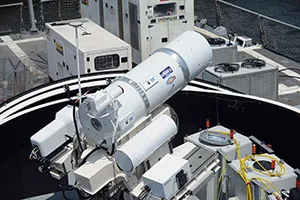
Defense innovation through energy weapon development stands as one of the fastest evolving future technologies. These high-energy lasers (HEL) and directed-energy weapons (DEW) offer significant advantages over traditional firearms:
- Unlimited ammunition: The weapons function without limitations because they maintain an endless supply of ammunition when they have access to power.
- Speed of light attack: These weapons eliminate targets within split seconds because they attack at the speed of light.
- Minimal collateral damage: Businesses engage the same level of precision during energy weapon usage that prevents damage outside the target area.
Military institutions now use this technology to test laser weaponry systems for both aircraft carriers and military aircraft in addition to land defense systems which indicates that laser warfare will soon become practical in the field.
Conclusion: The Future of Defense
The progress of defense depends entirely on the ongoing technological advancement pursuit. The evolving battlefield will combine artificial intelligence with robotic systems and quantum computing elements and cybersecurity capabilities to determine future operational security aspects.
The progress of defense depends entirely on the ongoing technological advancement pursuit. The evolving battlefield will combine artificial intelligence with robotic systems and quantum computing elements and cybersecurity capabilities to determine future operational security aspects.
Defense preparations for future obstacles remain unclear to society. New military technologies are advancing exponentially thus future security frameworks will become more artificial yet intellectually advanced while being incredibly challenging to predict.
Call to Action
Defining defense strategies by changing technology requires staying up to date. People must track modern cybersecurity developments and autonomous defense drone progress and blockchain security advancements to know about national war preparations.
 Our Services
 Media Pack Download
 Newsletters
 Industrial Events