

Top Next-Gen Military UAV Technologies Redefining Aerial Superiority
Introduction: The Strategic Shift toward Autonomous Air Dominance
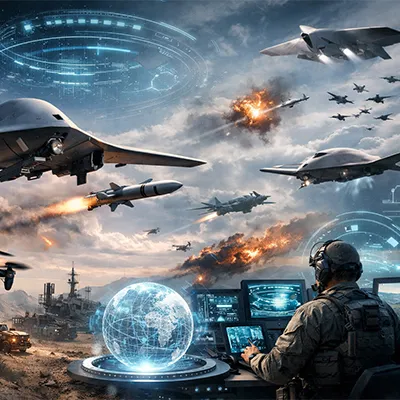
The battlefield that is currently being witnessed has been fundamentally changing due to the high rate of development of Next-Gen Military Unmanned Aerial Vehicles (UAV) Technologies. What started with the remotely piloted reconnaissance platforms has turned out to be the highly autonomous, intelligent and networked Military UAVs that are able to redefine the strategies of air dominance. The Unmanned Aerial Vehicles of today are not support devices anymore, they have become core elements in the integrated defense systems, affecting surveillance, strike missions, electronic warfare and projection of force.
With the world defense budgets focused on speed, precision, and reduction of risks, Military Drones have now become a necessity. The world has become dominated by software intelligence, sensor fusion, and autonomous decision-making as well as advanced propulsion, than by the sheer size of an aircraft or the ability of a pilot. This article will discuss the new technology of the drones in the military to achieve air dominance and how the next generation of drone systems are transforming the future of air power.
Understanding Next-Generation Military Drones
Definition: Next-Generation Military Drones
Next-Generation Military Drones imply superior Military Drone Systems incorporating autonomy, artificial intelligence, superior sensors, stealth features and secure communications to execute intricate operations with minimum human pilot intervention.
Contrary to the previous remotely piloted aircraft, Next-Generation Military Drones are intelligent nodes in a larger combat net. They work hand in hand with manned aircrafts, ground troops and space based capabilities to facilitate real time situational awareness and joint decision making.
The Evolution of Military UAVs in Modern Warfare
The development of UAVs in the military is indicative of the overall change in military war doctrine. The initial platforms were mainly utilized in intelligence, surveillance as well as reconnaissance missions. Nevertheless, the present Unmanned Aerial Vehicles are now able to conduct multi-mission operations such as precision attacks, electronic countermeasures, battlefield logistics, as well as continuing surveillance.
This shift has been driven by the advancement of onboard computing capability, miniaturized sensors and satellite communications. As a result, the application of Military Drones is currently increasing in the unfriendly airspaces and the risk of operation in the conventional manned aircrafts is increased.
Advanced UAV Technologies Driving the Next Wave of Innovation
Artificial Intelligence and Autonomous Decision-Making
The focus of Advanced UAV Technologies is artificial intelligence. The algorithms that are powered by AI can assist drones to work with large volumes of data in real time, search objects, identify threats, and adjust the mission parameters dynamically. Such a capability plays a significant role in decreasing cognitive load to human operators and enhancing the effectiveness of the missions.
Military Drone Systems have autonomous navigation system such that they can work in GPS-denied conditions so that the mission can continue even in the conditions of electronic warfare. The technologies are a central role in the next-gen UAVs of aerial combat mechanisms in the future where speed and versatility become the main assets.
Sensor Fusion and Multi-Domain Awareness
The Unmanned Aerial Vehicles of modern world incorporate electro-optical, infrared, radar, and signals intelligence sensors into a single unit. Sensor fusion allows drones to create detailed operation images, which can be used by commanders to have actionable intelligence.
This would be especially useful during joint operations where aerial superiority capabilities made possible by military UAVs should be synchronized with naval, ground, cyber, and space-based capabilities. The capability to exchange intelligence across platforms easily enhances coordination and response time in the battlefield.
Stealth, Survivability, and Advanced Materials
Next-Gen Military UAV Technologies have been characterized by stealth technology. The drones can intrude into the areas of the airspace with high defense using low observable airframes, radar-absorbing material and dynamic systems of the camouflage.
Swarm tactics and expendable drone concepts are also used to increase survivability with numerous Military UAVs being deployed to saturate the enemy defenses. This change is a challenge to the old models of air defense and changes the economic nature of air warfare.
Network-Centric Military Drone Systems
Definition: Network-Centric Warfare
Network -centric warfare is the combination of sensors, platforms and command systems to form a single digital network that improves situational awareness and operational performance.
Military Drone Systems are gradually being structured as networked platforms and not systems. Use of secure data connection and encrypted communication protocols will enable drones to be used as flying relays to expand the coverage of military networks. This interconnection facilitates cooperative engagement plans, in which the Military Drones will aid the manned planes, guns and missile systems in real time.
Swarm Technologies and Cooperative UAV Operations
Swarm intelligence is one of the most disruptive emergent drone technology in terms of military air dominance. Swarm operations have several Unmanned Aerial Vehicles that communicate with each other with data and collectively adjust to mission requirements.
These systems bring the redundancy, resilience, and scalability to the military operations. Next-Generation Military Drones that have been swarmed can carry out area denial attacks, decoy operations and reconnaissance with greater efficiency than has been possible before, and disturb the planning of enemy countermeasures.
Propulsion and Endurance Innovations
The endurance and range of Military UAVs is being expanded by new innovations in propulsion systems. New long-range missions with lesser thermal and acoustic heats are being made possible by hybrid-electric engines, hydrogen fuel cells and high efficiency turbofans.
The long-range capabilities make Military Drones more strategic especially in border patrol, marine patrol, and long-range missions of ISR. These systems complement aerial capabilities that are aided by military UAVs in that they ensure high levels of presence in areas of key interest.
Short Table: Key Capabilities of Next-Gen Military UAVs
| Capability Area | Strategic Impact |
| Autonomous Navigation | Reduced reliance on human control in contested environments |
| AI-Based Targeting | Faster threat identification and engagement |
| Stealth Design | Enhanced survivability in high-risk airspace |
| Swarm Operations | Increased resilience and tactical flexibility |
| Secure Networking | Real-time coordination across military domains |
Industrial and Defense Market Implications
Next-Gen Military UAV Technologies are transforming the world defense industrial environment. Aerospace, AI software companies, sensory developers, and cybersecurity providers are becoming more active in joining together to provide integrated UAV solutions.
The convergence brings about new opportunities in supply chains to B2B stakeholders. Suppliers of components, systems integrators, and data analytics companies are very important in facilitating Advanced UAV Technologies. Governments and defense contractors are focusing on the modular, upgradeable platforms capable of developing with the changes in the threats.
The Role of Next-Gen UAVs in Future Aerial Combat Strategies
Next-gen UAVs are not only the solution to the replacement of manned aircraft in the future aerial combat strategies. Rather, these platforms are used to complement human pilots using the manned-unmanned teaming concepts. UAVs are used as force multipliers, performing risky tasks and thus saving human lives.
Within conflict scenarios in the future, it is probable that Military Drones will serve as the initial phased strike, disabling air defenses and reconnaissance information prior to manned assets approaching conflict areas. Such layer of strategy improves the success of the mission besides minimizing the cost of operations.
Security, Ethics, and Regulatory Considerations
With increasing autonomy of Military UAVs, there are increased ethical and regulatory issues. There should be a change in decision making power, accountability, and rules of engagement in line with technological abilities. Military agencies are spending a lot of money to have safe AI governance systems to have responsible deployment.
Another issue that is critical is cybersecurity. The security of Military Drone Systems against information leaks and electronic disruptors is a critical step of ensuring credibility of the autonomous operations.
Industry FAQ Summary
How are Next-Gen Military UAV Technologies different from legacy drones?
They combine AI, autonomy, stealth, and networked operations, which allow complicated missions and minimum human intervention.
Why are Military UAVs critical for aerial superiority?
They offer continuous surveillance, quick reaction and less operational danger thus defining the way air dominance is secured.
What industries benefit from military drone advancements?
The UAV innovation is beneficial to aerospace, defense electronics, AI software, cybersecurity, propulsion systems, and materials engineering structures.
Conclusion: Redefining the Future of Aerial Dominance
Next-Gen Military UAV Technologies have evolved very fast and this is a breakthrough in the process of gaining and sustaining air superiority by nations. Incorporating the elements of autonomy, intelligence, and networked operations, Military UAVs are turning contemporary warfare into a data-driven multi-domain effort.
With the ongoing maturity of the emerging drone technologies in the military air dominance, it can only be expected that Next-Generation Military Drones will become more and more important strategically. To defense institutions, business stakeholders in the B2B industry alike, these innovations no longer represent a best-to-have option but an absolute necessity of keeping abreast with the changing environment of worldwide security.
 Our Services
 Media Pack Download
 Newsletters
 Industrial Events