

How Directed Energy Weapons Are Revolutionizing Counter-UAV and Missile Defense in 2025
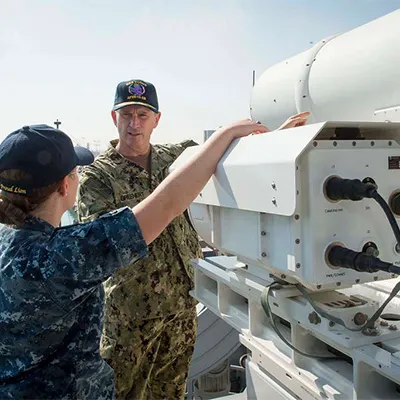
The changing nature of threats in a world where the threats are fast, small and elusive makes the traditional defense mechanisms insignificant. Civilian Drones (UAVs) and advanced Missile technologies have become a threat to the international security agencies. But what would happen though a beam of light would stop them dead in its tracks? It is 2025 and Directed Energy Weapons (DEWs) are no longer in works but a much-needed reality that has changed the face of the battlefield.
This development has drawn the attention to Counter-UAV Systems and Laser Defence Systems which provide potential to offer accurate, scalable and cost-efficient applications in contemporary warfare. So what exactly are DEWs for drone threats doing to the Laws of Engagement in Drone and Missile Counteraction?
The Rise of Directed Energy Weapons: A 2025 Breakthrough
Directed Energy Weapons refer to a type of technology which requires a very concentrated form of energy e.g. lasers or microwaves focus their energy such that they are able to either disable or to destroy enemy targets.
By 2025, they will be the focus of future defense policies, specifically directed energy in mitigating UAVs, UAV neutralization with directed energy, and directed energy in missile interception.
As the UAV incursions over military and civilian airspace continue to increase, the countries have had to invest in DEWs for drone threats. These are alternatives that do not only guarantee surgical precision but also scalability of operation. The ability to neutralize one or more drones within a short amount of time in close succession without the need to reload targets and resupply could prove life-saving in a contemporary threat environment, and all of that could be done using a single DEW platform.
How Counter-UAV Systems are Being Reinvented
The past years were characterized by the explosion in the commercial and military use of drones. The result has been tactical benefits of hostile actors through their inexpensiveness and accessibility, forcing countries to consider an option to revise aerial protection. In this case, there has been the introduction of Laser Defence Systems with counter-UAV Systems that have taken the centre stage.
These systems are used in defense by an application of high-energy laser weapons for defense to follow, lock and disable the UAVs in flight.
This precision capability of the DEWs makes the difference as unlike with traditional munitions, it will be possible to use UAV neutralization with directed energy on precision targeting, which will be carried out in such a circumstance that no collateral damage is likely to be caused and hence it makes this a suitable munition to use in cities and sensitive areas.
In a single training session with the U.S. Navy in the start of 2025, a laser-based system successfully intercepted and destroyed five drones in ninety seconds. What will every engagement cost? Less than a dollar of electricity. Huge mins compared to the cost of the traditional missile intercept ($1 million or more per intercept) also cries out the opportunity of DEWs for drone threats as a long-term solution.
Missile Defense Enters the Laser Era
Although there is an immediate and extensive concern about drones, missile threats in the form of hypersonics and hypersonic versions are essentially proving hard to intercept. This makes the fact that trends in 2025 laser missile defense systems are very much pinned on directed energy in missile interception.
The DEWs also differ, unlike previous generations of missile defense that use kinetic interceptors, in that they have the capability of destroying missiles at an earlier stage during their boost phase - when they have not already been able to deploy decoys or travel as multiple warheads. The most important thing, in this case, would be the real-time tracking and autonomous defense systems, as algorithms powered by AI will guide lasers with sub-millimeter precision.
Such Laser Defence Systems have the ability to attack a number of missiles simultaneously by using tracks predicting models and radar merge. This is a transformation of the reaction defensive model to an anticipatory or prediction defensive model which is revolutionary in environments where time is life.
Precision Targeting with DEWs: How It Works
DEWs precision targeting is based on the combination of different types of AI, electro-optical sensors, and advanced radar systems. The detection of a UAV or a missile and its distance trajectory, speed, altitude, and weather conditions can be computed in milliseconds with the DEW system. Then it targets a particular spot with its energy beam like the motor of a drone or fuel cell of a missile making it fail or turn into ashes immediately.
This accuracy is very precise and reduces collateral damage meaning that DEWs for drone threats are quite effective in urban places.
As an example, in 2025 a DEW system deployed at a German military equipment show successfully showed the capability to disable a drone camera and still recover the drone unharmed - something no kinetic weapon could accomplish.
Such surgical attacks are vital in situations where a plane invades domestic airspace, when shooting the drone entirely could risk lives of people or property. In this case, UAV neutralization with directed energy represents the optimal level of the balance of control and force.
Autonomous Defense Systems and Their Integration with DEWs
Another massive step in 2025 will be the use of autonomous defense systems among DEWs. These systems demand very little input of human intelligence as machine learning is used to detect friendly and unknown aggressive UAVs or missiles.
As an instance, medical units on Israel-border patrols utilized mobile autonomous DEW trucks fitted with real-time image assets as well as panoramic sensors. These units are equipped to constantly patrol the skies identifying a threat automatically and attacking it using high-energy laser weapons for defense to eliminate it before it gets into restricted areas.
These deployments indicate the direction of Counter-UAV Systems towards self-sufficient and quicker response. The automation also drastically decreases the response time, which is down to the millisecond range as opposed to minutes, when swarm drone attacks are involved or when multiple rockets are launching instead of just one.
Market Insights: Global DEW Adoption in 2025
| Region | Key Deployments | Leading Technologies | Investment Growth (2024–2025) |
| USA | Air Force laser pods, Navy lasers | Lockheed’s ATHENA, Raytheon’s HELWS | +22% |
| Israel | Border turrets, Iron Beam | Rafael’s Iron Beam, Elbit’s Skylock | +18% |
| India | DRDO laser programs, drone defense | DURGA II, anti-drone laser systems | +25% |
| China | Satellite-based DEWs, mobile units | Poly Defense, Norinco systems | +27% |
| Europe (NATO) | Airport drone shields, urban lasers | MBDA's Dragonfire, Rheinmetall’s HEL | +19% |
This table shows how the world has shown its increased interest in 2025 trends in laser-based missile defense systems and Directed Energy Weapons. As defense budgets shift to the agile precision-oriented paradigm, DEWs for drone threats and directed energy in missile interception have fast become major areas of acquisition focus.
Challenges and Future Outlook
Nevertheless, DEWs do not come without their limits. Such atmospheric interference as fog, or rain, or dust may cause scatter of laser beams and make them less effective. Power is another challenge - protection of high-energy laser weapons for defense implies using little but very powerful sources of energy that are able to operate in portable or airborne systems.
Moreover, the defense industry has already started to cope with them. Changes in fiber laser technologies and solid-state batteries are increasing the beam quality and energy efficiency.
Besides, there are emerging hybrid systems that can integrate Laser Defence Systems with the microwave type that are meant to neutralize ground-based and also air threats.
In the future, the combination of autonomous defense systems and DEWs may develop into multi-purpose security arrangements that will secure the military installations, state, and even business facilities such as airports and sports stadiums.
Why 2025 Is a Turning Point for DEWs
Why now? Why is 2025 such a milestone already in the Directed Energy Weapons?
Three major accelerators hold the answer to this question, namely the technological maturity, the geopolitical necessity, and fiscal efficiency.
We are technologically advanced to a point where the targeting using DEWs is technologically feasible, and not just to talk about it but to prove it in real-life conditions. A geopolitical trend has also led the DEWs to be not only a desirable strategy, but also a necessary one since it is geopolitically manifest in the multiplication of drone and missile threats posed by both state and non-state actors. And, in a financial perspective, a laser strike of a dollar is difficult to disagree to compare to the million-dollar interceptors.
The question governments have stopped asking is whether or not to implement DEWs for drone threats or directed energy in missile interception, but rather when can they roll them out in large numbers.
Final Thoughts
By 2025, directed energy weapons are predicted to completely transform state defenses against unmanned aerial vehicles and missiles. They are a quantum similarity leap forward in fighting - silent, accurate and almost infinite in ammunition supply.
In the wake of Counter-UAV Systems, Laser Defence Systems and autonomous defense systems, the battlefield is transforming into a domain of beams, bots and bytes. Be it directed energy to neutralize UAVs or directed energy in missile destruction, there is no question of the future being laser-clad.
The only certainty is that DEWs will alter not only the nature of war strategy but also what it means to be safe in a world of intelligent adversaries, as the trends for laser-based missile defense systems in 2025 remain to emerge.
 Our Services
 Media Pack Download
 Newsletters
 Industrial Events