

Top AI-Powered Command Systems Transforming Military Decision-Making
Quick Answer
AI Military Command Systems are software platforms that use machine learning, real-time sensor fusion, and predictive analytics to help commanders make faster, better-informed decisions on the battlefield. The leading systems — spanning AI-enabled C4ISR platforms, autonomous data-fusion tools, and AI-driven command and control systems for modern military operations — are reshaping how militaries plan missions, track threats, and respond to fast-moving crises. Below, we break down what these systems are, why they matter, and which categories of AI command and control systems are leading the shift.
Why Military Command Systems Needed an AI Upgrade
For decades, Military Command Systems relied on human analysts to sift through radar feeds, satellite imagery, signals intelligence, and field reports, then hand-build a picture of the battlespace. That process worked when the volume of data was manageable. It doesn't work anymore.
Modern conflict zones generate an overwhelming amount of information every second — drone footage, cyber activity logs, troop movement data, weather patterns, and communications intercepts, all arriving at once. Human teams, no matter how skilled, simply cannot process that volume fast enough to keep pace with the speed of modern warfare. A delay of even a few minutes can be the difference between a successful defensive maneuver and a missed threat.
This is the gap that AI Command and Control is designed to close. Instead of replacing human judgment, AI systems now handle the heavy lifting of data collection, pattern recognition, and threat prioritization, freeing commanders to focus on strategy and final decisions. The result is a new generation of military command systems that are faster, more accurate, and better equipped to operate across land, air, sea, space, and cyber domains simultaneously.
What Makes a Command System "AI-Powered"?
Not every digital command tool qualifies as an AI-powered military command system. True AI-driven platforms typically include a combination of the following capabilities:
- Real-time sensor fusion — combining data from radar, satellites, drones, and ground units into a single operational picture
- Predictive analytics — forecasting enemy movement or logistical bottlenecks before they happen
- Autonomous threat detection — flagging anomalies faster than human analysts can manually review feeds
- Natural language processing — parsing intercepted communications or reports at scale
- Decision-support algorithms — recommending courses of action based on historical and live data, while keeping a human in the loop for final approval
Together, these capabilities form what analysts often call AI-enabled C4ISR platforms — systems built around Command, Control, Communications, Computers, Intelligence, Surveillance, and Reconnaissance, now supercharged with machine learning.
Top AI-Powered Command Systems Transforming Military Decision-Making
Here's a closer look at the categories of systems leading this transformation, based on publicly reported military modernization programs across the U.S., NATO allies, and other advanced militaries.
1. AI-Driven Battle Management Platforms
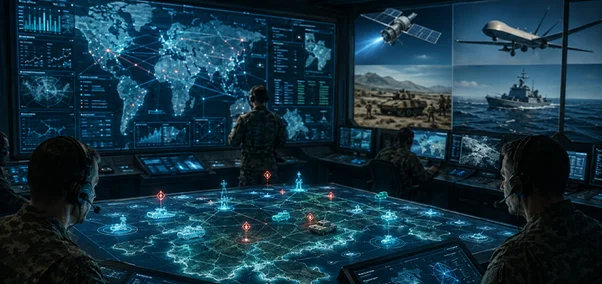
These platforms sit at the center of modern command centers, aggregating data from multiple branches of the military into a single dashboard. Instead of separate teams manually cross-referencing air, land, and sea reports, these systems automatically merge inputs and highlight the most urgent developments. Commanders get a live, continuously updated view of the battlespace rather than a static briefing that's already outdated by the time it's presented.
This category represents the backbone of AI-driven command and control systems for modern military operations, because it directly supports the "kill chain" — the sequence of steps from detecting a threat to responding to it — by compressing what used to take hours into minutes.
2. Predictive Logistics and Readiness Systems
Warfighting isn't only about combat — it's also about making sure fuel, ammunition, spare parts, and personnel are in the right place at the right time. AI-powered logistics platforms analyze historical usage patterns, maintenance records, and supply chain data to predict shortages before they occur. This reduces downtime for aircraft, vehicles, and ships, and ensures units are combat-ready when it matters most.
3. Autonomous ISR (Intelligence, Surveillance, Reconnaissance) Networks
Some of the most impactful AI-enabled C4ISR platforms are built around autonomous drones and satellite constellations that continuously scan for activity and automatically flag anomalies — such as unusual troop movement or vehicle convoys — for human review. Rather than requiring analysts to watch hours of raw footage, machine learning models pre-screen the material and surface only the segments that matter, dramatically cutting analysis time.
4. AI-Assisted Threat Prioritization Tools
In any active conflict, dozens of potential threats can appear simultaneously. AI command and control systems now assist commanders by ranking threats based on severity, proximity, and likelihood of escalation. This doesn't remove the human decision-maker from the loop — it simply ensures they're looking at the most critical information first, rather than working through an unranked list under time pressure.
5. Multi-Domain Integration Systems
Modern warfare spans land, sea, air, space, and cyberspace at once. Multi-domain AI command platforms are designed to connect these environments so that, for example, a cyberattack detected in one domain can automatically trigger alerts and defensive posture changes in another. This kind of cross-domain awareness was nearly impossible to achieve manually, but it's becoming a standard expectation for artificial intelligence for military decision support and battlefield management.
6. Natural Language Intelligence Processing Tools
A significant portion of military intelligence still arrives as unstructured text — reports, transcripts, and open-source information. AI language models are increasingly used to summarize this material, extract key entities, and translate foreign-language content in near real time, giving analysts a head start that used to take teams of linguists and researchers much longer to produce manually.
Benefits of AI Command and Control Systems
Military organizations adopting these technologies commonly report a few consistent advantages:
- Faster decision cycles. What once took a full staff meeting can now be summarized in a live dashboard update.
- Reduced cognitive overload. Analysts and commanders can focus on judgment calls instead of manual data-gathering.
- Improved accuracy. Machine learning models are less prone to fatigue-driven errors during long operations.
- Better resource allocation. Predictive maintenance and logistics tools reduce waste and downtime.
- Stronger situational awareness. Multi-domain fusion means fewer blind spots across the battlespace.
Challenges and Risks Worth Understanding
No responsible discussion of AI Military Command Systems is complete without acknowledging the risks involved.
- Data quality issues. AI systems are only as reliable as the data feeding them; corrupted or incomplete data can produce flawed recommendations.
- Over-reliance on automation. There's an ongoing debate about how much authority should be delegated to algorithms versus retained by human commanders, particularly for high-stakes decisions.
- Cybersecurity vulnerabilities. Highly networked command systems present a larger attack surface for adversaries seeking to disrupt or deceive them.
- Ethical and legal questions. International humanitarian law requires meaningful human control over the use of force, which shapes how militaries design and deploy these tools.
Because of these concerns, most modern programs are built around a "human-in-the-loop" or "human-on-the-loop" model, where AI accelerates analysis and offers recommendations, but a person retains ultimate decision-making authority — especially for any action involving the use of force.
The Future of AI-Enabled Military Decision-Making
Looking ahead, the trend across defense ministries and allied coalitions is toward greater interoperability — ensuring that AI-powered military command systems used by different branches, and even different allied nations, can share data seamlessly during joint operations. Expect continued investment in edge computing (processing data closer to where it's collected, such as directly on a drone or vehicle), more robust cybersecurity safeguards for these networks, and tighter integration between space-based sensors and ground command centers.
As these systems mature, the core goal remains consistent: giving human decision-makers a clearer, faster, and more reliable picture of a rapidly changing battlespace — not replacing their judgment, but reinforcing it.
Frequently Asked Questions
What are AI Military Command Systems?
They are software platforms that use artificial intelligence to collect, analyze, and present battlefield data, helping commanders make faster and more informed decisions.
How do AI command and control systems differ from traditional Military Command Systems?
Traditional systems rely heavily on manual data analysis, while AI-driven systems automate data fusion, threat detection, and predictive analytics, significantly reducing decision-making time.
Are AI-powered military command systems fully autonomous?
No. Most systems are designed with a human-in-the-loop approach, meaning AI provides analysis and recommendations while final decisions, especially those involving force, remain with human commanders.
What is the role of AI-enabled C4ISR platforms in modern warfare?
These platforms combine Command, Control, Communications, Computers, Intelligence, Surveillance, and Reconnaissance functions with machine learning to deliver a unified, real-time operational picture.
Why is artificial intelligence important for military decision support and battlefield management?
Because modern conflicts generate data faster than humans can manually process it, AI helps filter, prioritize, and interpret that information so commanders can act with speed and accuracy.
Final Thoughts
The shift toward AI-driven command and control systems for modern military operations isn't a distant, futuristic concept — it's already underway across major militaries worldwide. From predictive logistics to multi-domain threat fusion, these tools are reshaping how decisions get made under pressure. As adoption grows, the militaries that succeed will be the ones that strike the right balance: using AI to move faster and see clearer, while keeping human judgment firmly at the center of every critical decision.
 Our Services
 Media Pack Download
 Newsletters
 Industrial Events