

Best Multi-Domain Command & Control Platforms for Modern Defense Forces
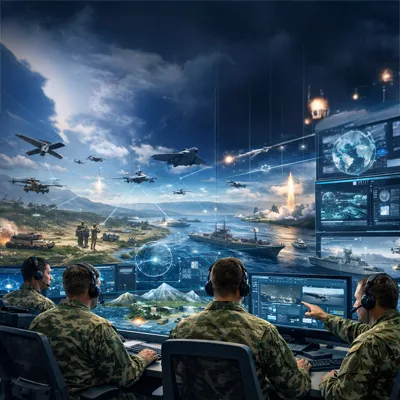
Amid the current trends of fast emerging threats and multi-dimensional battlefields, defense forces around the globe are moving toward integrated and networked combat operations, which disaggregates the domain barriers. The modern battlefield is no longer made up of land, sea and air, but rather encompasses cyber, space and electromagnetic spectrums. Multi-Domain Command and Control Platforms have become an inseparable part of such strategic environment and they can help a military leader to see, make a decision and take an action more quickly and more precisely than it ever happened before. The presented overall analysis explains why these systems are essential, what functionalities they provide, and which solutions are driving the development of joint and coalition defense operations.
Understanding Multi-Domain Command and Control
What Is Multi-Domain Command and Control?
The Multi-Domain Command and Control (MDC2) is the combined action, which allows military forces to coordinate their work in all sectors of the war, namely land, sea, air, space, cyber, and electromagnetic spectrum under a single working image. These platforms enable quicker decision-making processes by bringing the information of different sensors, systems and units together into a consistent picture of operations that commanders can rely on.
In the most basic sense, Multi-Domain Command and Control Platform is the intellectual nerve center of the contemporary defense operations, as such that forces are able to dynamically adjust to the threats and opportunities across domains. The systems are important during the time of peacetime deterrence and emergency reactions, as well as during high-intensity conflict.
Why Traditional C2 Alone Is Not Sufficient
In the classical C2 Platforms of the military, every domain tends to be isolated and each of them has its own data format and communication standards. Although it works well in more traditional settings, these systems do not perform well in the requirements of integrated warfare where speed, data fusion, and multi-domain awareness is of the focus. The advent of JADC2 and MDC2 programs highlights the paradigm shift of wholesome command and control solutions that can be used to integrate operations of joint and alliance forces at machine speed.
The Strategic Imperative for Advanced Command and Control Solutions
The Rise of Joint and Coalition Operations
The current-day approaches to defense focus on interoperability among the services (Army, Navy, Air Force, Space Force, Cyber Command) and with other countries. Joint Command and Control Solutions are consistent with this strategic need, providing a real time shared awareness, synchronized planning, and joint execution of missions. Whether it is the maritime task forces inherently guarding important shipping lanes or air defense missions against advanced missile threats; Multi-Domain Command and Control Systems are required to bring success to these operations.
Responding to Peer and Near-Peer Threats
The enemies that have high capabilities utilize domain overlap to make defense planning complicated. Hypersonic missiles, computer attacks, and threats on space do not consider the conventional boundaries of operations. Next-Generation C2 Platforms to multi-domain warfare aims to address this fact by supplying defense forces with adaptable, resilient, and scalable systems able to address the non-kinetic and kinetic combats in parallel.
Core Capabilities of Multi-Domain Command and Control Platforms
Unified Situational Awareness
Any strong Multi-Domain Command and Control System is marked with the capability to create an integrated operational image on the fly. This is the combination of sensor feeds, intelligence data as well as unit status of various sources and then a filter and prioritisation of information presented to commanders to enable them to take action. High-level data fusion engines and artificial intelligence (AI) systems are relevant to the minimization of informational overload and the identification of important events.
Decision Support and Predictive Analytics
In addition to awareness, efficient command platforms can be used to give decision support based on modeling of the consequences and recommended courses of action. Predictive analytics can be used to predict the moves of the enemy, determine the number that you lose, and allocate resources in the best possible way. These features are becoming critical in the high-paced settings that can put a difference of milliseconds between success or failure in a mission.
Secure, Resilient Communications
The command and control solutions should be able to work even when under attack by the adversaries. Modern Military C2 Platforms include encrypted resilient networks that remain connected and operational in hostile networks. These networks facilitate smooth exchange of data across the echelons and partners which allows distributed command even when there is physical or electronic interference.
Joint and Coalition Interoperability
Multi-Domain C2 Platforms are superior in cases where they support the collaboration of coalition partners who use different equipment, standards, and procedures. The key factors that make interoperability possible are standards-based interfaces, common data models, and federated security architectures because they maintain coherent operation of the allied forces without undermining either security or performance.
Leading Examples of Next-Generation C2 Platforms for Multi-Domain Warfare
In order to bring the technological environment into perspective, it is prudent to study the hallmark systems and structures that reflect the state of the art Multidomain Command and Control.
Unified Battle Management Systems
Unified battle management systems combine real time sensor feeds and tactical decision support and communications gateways. These platforms allow the facilitation of the joint battle rhythm capabilities, including air tasking orders, air maritime maneuver plans, and ground maneuver fight schedules, to be synchronized with domains. Their applicability increases with increasing autonomous systems and unmanned platforms in the defense forces.
AI-Enhanced Command Centers
Smart command centers made with AI are used to speed up the process of data analysis and pattern identification. These types of systems may detect anomalies in massive data sets, aid with classification of threats and enable responsive actions to dynamic battle spaces. The combination of man and machine is the future of more sophisticated Military C2 Platforms.
Distributed and Cloud-Enabled Architectures
The use of cloud computing and software-defined architecture have changed the manner in which C2 platforms are executed and enhanced. These solutions provide the ability to update quickly, insert modular capability, and operate distributed over geographically spread units infrastructure without a central vulnerability because these solutions decouple software with particular hardware.
Mobile and Edge C2 Nodes
The contemporary forces need flexibility. The mobile command posts with edge computing enable command and control to be taken to the location of need. These systems also provide the operators with situational awareness and decision making authority even under austere or quickly changing conditions.
How Defense Forces Evaluate Best Multi-Domain Command and Control Platforms
The evaluation of advanced C2 solutions demands not just the knowledge of the technological possibilities but also of the operational influence. The defense forces normally undergo strict assessment such as operational testing, cybersecurity testing and interoperability testing with the allied forces. Some important evaluation criteria would be:
- Scalability: Does the system allow huge alliances and growing sensor networks?
- Interoperability: Does the platform adhere to the international standards and does the platform support the joint operation with partners?
- Resilience: How resilient of the system is to cyber-attack or messages degradation?
- Usability: Does human-machine interface make sense and respond to different tactical situations in a natural way?
- Sustainability: Does the system have a long-range deployable basis and does it accommodate modular upgrades?
Solutions that are candidate solutions are commonly put through large exercises simulated by defense planners to ensure they can meet the requirements of a realistic multi-domain environment.
Integration Challenges and Solutions
Overcoming Data Standardization Barriers
Data standardization is one of the main problems of Multi-Domain Command and Control Platforms implementation. With heterogeneous systems, there is a risk of working with data that have incompatible formats making it hard to fuse the data. Such obstacles are mitigated with the assistance of standardized procedures, such as common tactical data connections and interchangeable message structure.
Ensuring Cyber Resilience
The more the command systems are interconnected the more vulnerable to cyber threats they are also. The military forces are consuming a lot of money by applying layered cybersecurity policy, including zero-trust architecture, round-the-clock surveillance as well as the capacity to respond.
These are not only safeguarding the core C2 infrastructure, but also the edge nodes that are deployed in a contested environment.
Training and Human-System Integration
The highly developed command platforms cannot be effective without the personnel who are operating them. The thorough training programs involving doctrine and simulation, as well as live exercise settings, assist the operators to learn to deal with complex systems and make reasonable decisions in the situation of pressure. Human-System Integration (HSI) activity is an optimization of interfaces to minimize the cognitive load and improve the quality of decisions.
A Framework for Implementing Joint Command and Control Solutions
Multi-Domain Command and Control Systems can only be operationalized by adapting a systematic implementation framework by defense forces:
Assess Operational Requirements
The initial stage is demarcation of mission sets, domain priorities and partner collaboration requirements. The information gained through this evaluation is utilized in the process of choosing platform capabilities.
Choose an Architecture Aligned with Strategy
The architecture should have the capability to support growth, access to coalitions, and fast reconfiguration regardless of its being cloud-native, on-premises, or hybrid.
Deploy in Phases with Feedback Loops
The iterative refinement can be achieved through incremental deployment. Operational unit responses to exercises makes sure that the system is evolved on the basis of actual usage scenarios.
Institutionalize Training and Doctrine
The training and doctrine should be aligned to technical capability as it describes how the platform will be used by the forces in joint operations. Constant education and certification support the operator competence.
Monitor and Upgrade Continuously
Because of the nature of technology being dynamic, the command platforms should be periodically updated to include new sensors, AI models, and security patches. It needs a sustainable upgrade route.
Glossary of Key Concepts
- Multi-Domain Command and Control Platforms: Combined systems that deliver the defense forces with integrated operational view and decision authority in all the warfare spheres.
- Military C2 Platforms: Conventional command and control systems which support planning, coordination and execution in particular areas or units.
- Multi-Domain Command and Control Systems: More sophisticated architectures which integrate heterogeneous domain C2 capabilities in a decision support system, which is real-time and interoperable.
- Joint Command and Control Solutions: The capabilities are that of assisting multibranch collaboration operations with various service branches and allies.
- Advanced Military C2 Platforms: Advanced C2 solutions involving the use of advanced technologies like AI, cloud computing product, and other resilient networking to support defense operations.
- JADC2 and MDC2: The coordination of the superiority of decisions on the level of domains was taken care of by acronym of Joint All-Domain Command and Control and Multi-domain Command and Control programs respectively.
Frequently Asked Questions (FAQ)
What is the difference between the multi-domain C2 platforms in the present and the past?
The recent platforms focus on the fusion of data, real-time cooperation, and the interoperability of services and partners forces that occur naturally. Compared to the legacy systems that require the ability to stay within their own area, more sophisticated solutions eliminate silos and facilitate a process of making decisions across the board.
How do advanced C2 solutions improve operational effectiveness?
These systems also reduce the decision loop and increase force responsiveness by enabling commanders to have a coherent view of the battle space, predict areas of threats, and access quick channels of communication. They also favour distributed command nodes, which do not make them dependent on one point of failure.
Can multi-domain platforms integrate with existing defense systems?
Yes, the current best-in-campus solutions are open standards designed and with modular interfaces, which can integrate with older sensors, weapons, and communications infrastructure so they can be upgraded over time instead of being replaced wholesale.
Conclusion: Toward Decision Superiority
The world is changing drastically in the sphere of defense. Countries have enemies who can challenge all aspect at once, with cyber-attacks, space denial missions, etc. In response, defense forces need to implement Multi-Domain Command and Control Platforms that provide integrated awareness, joint planning capabilities, and resilient communications. Military C2 Platforms of best-in-class are not mere technological enhancements, but strategic facilitators of operational superiority.
As agility, collaboration, and speed remain the principal concerns of defense strategies, the importance of advanced command and control solutions to support joint defense operations will continue to increase. Through investing in next generation C2 systems and creating an ecosystem that enables interoperability, training and resilience, defense forces can put themselves in a position to provide decision superiority in the most complex environments of the 21st century.
 Our Services
 Media Pack Download
 Newsletters
 Industrial Events