

AI-Enhanced Command and Control (C2) Systems: Transforming Military Decision-Making and Battlefield Intelligence
Digital innovation is transforming the traditional military strategies in the constantly changing world of present-day defense. One of the most revolutionary changes consists of the development of AI-augmented command and control systems. These newer platforms are not only making the operations on the battlefield efficient but they are also changing the way military forces prepare, perform, and innovate in real-time environment. So what does AI bring to the command and control? But why now more than ever should the AI-enhanced C2 systems be adopted?
The adoption of AI into C2 systems is not just a technological jump - it is a strategic renaissance of a combination of brute computing and tactical brilliance. With war becoming more complex and data intensive, the need to develop smart C2 solutions has experienced a shooting demand. This paper looks into the potentials of AI in tactical operations, the advantages of AI, as well as the future of military AI applications that revolves around command and control superiority.
The Shift toward Advanced Military Command Systems
The problem with the Traditional C2 systems, although efficient in their era, was that they tended to choke on large amounts of information, had slow response times, and could not adapt well to changing environments. The modern military command centers use advanced AI to eliminate these challenges. They provide an unexcelled scalability, processing speeds, and decision support mechanisms.
Having the AI integrated into the very fabric of the military infrastructure, the commanders will be able to make informed decisions in the timeframe that was not feasible before. Such AI-based decision making tools can analyze huge volumes of data, including satellite imagery, human intelligence reports, and others to provide actionable intelligence in a matter of seconds.
However, what are the AI advantages in C2? They run between accelerated threat identification and predictive analysis to effective allocation of resources and mission planning. AI is not a helping hand - it enhances the human decision-maker, turning into a strong companion both in and out of the battlefield.
How Does AI Improve Command and Control?
So how does AI enhances command and control? Suppose we begin by taking a step back and asking the question behind. The answer lies in the real-time data processing and situation reasoning.
The AI backed command and control systems are able to synthesize data across various domains - air, land, sea, cyber, and space. They next use machine learning models to evaluate trends, predict adversary behavior, and model various conditions of operations. This allows quicker response time and long- aims-specific decisions.
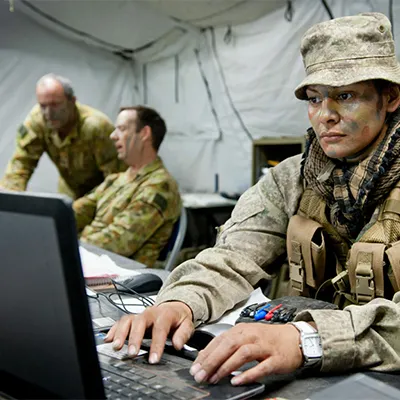
Among the most interesting uses is real-time battlefield analytics. In real-life combat situations, AI is capable of processing drone videos, hacking communications, and performing terrain analysis, giving commanders a complete situational awareness on-demand. These intelligence products permit adaptive maneuvers, better unit positioning, and decrease threats to personnel.
By introducing automated command support, AI platforms will auto-generate mission briefs, assess the potential courses of action, and recommend the best courses of action. Such functions supplement, instead of substituting, human abilities, meaning that strategic control will still be in reliable hands, with AI doing the hard work.
Why Adopt AI-Enhanced C2 Systems Now?
What is the point in adopting AI-enhanced C2 systems? The solution is digital maturity and geopolitical imperative coming together.
The battleground has been reduced into a higher-dimensional chess board where the winner takes all is based on speed, accuracy, and foresight. Modern engagements are just too fast to be maintained using traditional systems. In the meantime, competitors are working on and fielding AI, which requires an active approach on the part of technologically advanced countries.
Besides that, the amount of data generated by sensors, satellites, wearables, autonomous systems, and so on is overwhelming to process manually.
C2 systems with AI sift through this torrent of data, sorting, and ranking it so that decisions can be made more swiftly and more informed.
Furthermore, surveillance is no longer the only component of military AI use. Whether it is cyber defense, electronic warfare or optimization of logistics AI is finding its place in all areas of operations. The investment into the AI-assisted command and control is a guarantee of strategic benefits and operational robustness.
AI for Tactical Operations: Speed and Precision in Combat
Contemporary conflict requires maneuverability. Tactical AI offers that advantage in the form of smart reconnaissance, automated threat identification, and all-time strategy generation.
Consider a forward deployed force that runs in to unanticipated opposition. In the legacy systems, failure to pass information in time and failure to get full information may compromise the mission. Intelligent C2 solutions will ensure that the data available on the ground in the unit is analyzed in real time and the system will provide alternative routes, reserve forces, and support possibilities.
It is not merely automation but AI-based decision making modelled by awareness of the context. And it is rapidly becoming a norm in advanced military command and control.
Enhanced Situational Awareness with AI: Seeing the Bigger Picture
AI-augmented situation awareness is one of the representative capabilities of AI-enhanced command and control.
That situational awareness which used to depend on maps, scouts, and radio reports now runs on an AI-linked digital mesh of connected devices.
AI algorithms consume and process UAVs, satellite, and IoT-enabled soldier’s data to generate a live multi-layered operational map. This virtual battlefield can not only display the location of forces, but also forecast the effects of weather, determine the likely intentions of the enemy, and gauge the indicators of morale by carrying out sentiment analysis on the captured communications.
The result is less lag in decision making, fewer surprises and accuracy of action.
When integrated with automated command support, commanders have something better than data--they have insight.
The Competitive Landscape: Who’s leading the AI-C2 Race?
| Country | AI Integration in C2 | Notable Programs |
| USA | High | Project Maven, Joint All-Domain Command and Control (JADC2) |
| China | Growing | Intelligentized Warfare Strategy |
| Russia | Moderate | AI-enhanced ISR platforms |
| Israel | Advanced | AI-assisted border surveillance & Iron Dome analytics |
The US and its partners are spending billions of dollars on AI in C2 systems to achieve an advantage. Meanwhile, the emerging powers are gaining faster, and AI-enhanced command and control become a strategic necessity.
Market Insights: Where is the Industry Headed?
Recent defense market studies show that the world market in AI-enhanced C2 systems will top US$15 billion by 2030. It grows on the basis of:
- Increasing geopolitical tensions
- Rising cases of cyber warfare
- Unmanned systems demand
- Real-time analytics on the battlefield
Lockheed Martin, Raytheon Technologies, and Northrop Grumman among others are already working on intelligent C2 solutions that can be integrated into the existing infrastructure. In the meantime, startups and AI experts are offering specialized solutions in the area of automated command support and AI to tactical operations.
Challenges and Ethical Considerations
Although the future of AI-boosted command and control is more exciting, it is not void of worries. Excessive trust in algorithms, the possible adversarial attack on artificial intelligence models, and the ethical aspects of autonomous decision-making are in question.
The use of AI in the military should adhere to the views of international law and respect to human rights. The AI-driven decision making should not pose a threat to the military action but improve it, which is possible through transparency, human control, and extensive testing.
Conclusion: The Future of Command and Control Technology
The question ceases to be about the reasons to adopt AI-enhanced C2 systems but about the speed with which they can be rolled out at scale. With the convergence of the physical and digital battlefield, the requirement to have swift, knowledgeable, and intelligent reactions has never been higher.
The era of command and control technology will be characterized by learning, adapting and acting - without human intervention at each instance. AI will not take the place of military leaders, but it will become an invaluable assistant in achieving success in a mission.
In this computerized era of war, the AI-minded command and control entirely driven by AI in C2 systems are the foundation of strategic supremacy. Whether it is automated command support or real-time battlefield analytics, military AI applications, or AI tactical operations, the revolution has already begun.
The battle terrain is no longer the same. The command has to change. And AI is taking the lead.
 Our Services
 Media Pack Download
 Newsletters
 Industrial Events