

Top NBC Protection and Life Support Systems for Modern Military Operations
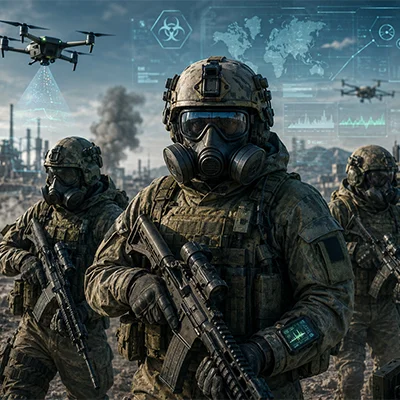
As military threats evolve beyond conventional warfare, armed forces are investing in intelligent protection ecosystems capable of defending personnel against nuclear, biological, and chemical hazards while sustaining operational effectiveness. Modern NBC Protection Systems, integrated life support technologies, and AI-enabled monitoring platforms are transforming soldier survivability by combining protection, mobility, communication, and physiological support into unified defense solutions. This article explores how next-generation CBRN defense and life support innovations are redefining battlefield resilience for future military operations.
Top NBC Protection and Life Support Systems for Modern Military Operations
The Battlefield Is No Longer Defined by Bullets Alone
Military planners have spent decades preparing for kinetic warfare, but today's operational environment is increasingly influenced by invisible threats.
Chemical agents can spread across urban infrastructure.
Biological pathogens can incapacitate forces without a single explosion.
Radiological contamination can deny strategic territory for weeks.
Nuclear incidents can disrupt military operations across entire regions.
These evolving threats have shifted military modernization efforts from simply protecting soldiers with armor to creating intelligent survivability ecosystems.
Modern NBC Protection Systems are no longer isolated protective suits or gas masks stored for emergencies. They are becoming digitally connected, sensor-driven platforms that continuously assess environmental threats, monitor soldier health, regulate breathing systems, communicate contamination data, and integrate directly with battlefield command networks.
Likewise, Military Life Support Systems have evolved from emergency breathing devices into advanced physiological support platforms capable of sustaining soldiers during prolonged exposure to hazardous operational environments.
The result is a new generation of combat readiness where protection is proactive rather than reactive.
Why Modern Militaries Are Investing Beyond Traditional Protective Equipment
For decades, military protection largely focused on shielding personnel after contamination occurred.
Today's strategy focuses on preventing exposure before soldiers even realize danger exists.
Military organizations are investing heavily in technologies capable of:
- Detecting airborne threats in real time
- Predicting contamination spread using AI
- Automatically activating protective equipment
- Supporting soldiers physiologically during extended missions
- Maintaining operational effectiveness under extreme environmental conditions
Rather than treating NBC defense as a standalone capability, defense organizations increasingly view it as an integrated battlefield ecosystem.
This shift explains the growing demand for Advanced NBC protection systems capable of connecting sensors, communication platforms, protective gear, medical monitoring, and mission command into one synchronized architecture.
The Evolution of NBC Protection Systems
The earliest NBC Protection Systems were designed primarily to isolate personnel from hazardous agents.
Modern systems are significantly more sophisticated.
Today's solutions combine:
- Intelligent respirators
- Lightweight protective garments
- Wearable contamination sensors
- Environmental monitoring devices
- Smart filtration technologies
- AI-assisted threat identification
- Automated alert systems
Instead of relying solely on manual decision-making, these systems continuously monitor changing battlefield conditions and provide commanders with actionable intelligence.
This dramatically reduces response times while improving soldier survivability.
From Protection to Performance: The Rise of Integrated Soldier Systems
One of the most significant trends in military modernization is the integration of protection with operational performance.
Protective equipment traditionally increased fatigue.
Heavy suits restricted mobility.
Respirators reduced communication quality.
Thermal stress shortened mission duration.
Modern defense engineering is solving these challenges through Integrated life support systems for soldiers.
Instead of forcing personnel to compromise between protection and combat effectiveness, integrated systems optimize both simultaneously.
Examples include:
- Climate-controlled protective clothing
- Intelligent cooling systems
- Wearable biometric monitoring
- Oxygen regulation technologies
- Hydration management systems
- Digital communication interfaces inside respirators
These capabilities enable soldiers to remain operational for significantly longer periods without compromising safety.
Next-Generation CBRN Protection Systems Are Becoming Intelligent
Traditional CBRN Protection Systems focused primarily on filtration and containment.
The newest generation focuses on prediction.
Artificial intelligence now analyzes:
- Air quality
- Wind direction
- Chemical signatures
- Biological particle concentrations
- Radiation intensity
- Environmental sensor networks
Instead of waiting for contamination confirmation, intelligent systems estimate exposure probabilities before personnel enter hazardous zones.
This predictive capability represents one of the biggest advances in Military CBRN defense technologies.
Future systems may automatically recommend safer movement routes, optimize troop positioning, and dynamically adjust protective measures based on evolving battlefield conditions.
Life Support Systems Are Becoming the Soldier's Second Nervous System
Modern Military Life Support Systems extend well beyond oxygen supply.
They increasingly function as wearable physiological support platforms.
Emerging capabilities include:
Continuous Health Monitoring
Embedded biosensors monitor:
- Heart rate
- Respiration
- Body temperature
- Blood oxygen levels
- Hydration status
- Stress indicators
These metrics help commanders evaluate combat readiness in real time.
Intelligent Breathing Management
Advanced respiratory systems automatically regulate airflow depending on physical exertion and contamination levels.
This improves endurance while reducing fatigue during extended operations.
Thermal Regulation
Operating inside protective suits often creates severe heat stress.
New cooling technologies circulate temperature-controlled fluids or phase-change materials, significantly improving comfort and endurance.
Fatigue Prediction
AI algorithms increasingly estimate when soldiers approach physiological exhaustion, enabling proactive rotation planning before performance deteriorates.
These innovations make Military life support systems for hazardous operational environments significantly more effective than previous generations.
Integrated NBC and CBRN Protection Is Changing Battlefield Decision-Making
Military protection is no longer an isolated function handled solely by individual soldiers.
Instead, protection data is becoming a command-level asset.
Modern Integrated NBC and CBRN protection solutions for soldier survivability connect multiple battlefield systems, including:
- Ground sensors
- Reconnaissance drones
- Satellite imagery
- Tactical communication networks
- Soldier wearables
- Mobile laboratories
- Command centers
The result is a continuously updated contamination picture shared across operational units.
Rather than reacting independently, every soldier operates with synchronized threat awareness.
Autonomous Detection Technologies Reduce Human Exposure
Another transformational trend involves robotic hazard detection.
Instead of exposing personnel directly, militaries increasingly deploy:
- Autonomous ground vehicles
- Reconnaissance robots
- Drone-mounted chemical detectors
- Radiation mapping UAVs
- Remote biological sampling systems
These platforms identify hazardous environments before troops arrive.
Combined with Advanced CBRN protection technologies enhancing combat safety, autonomous detection dramatically lowers operational risk while improving mission planning.
Wearable Intelligence Is Reshaping Military Protective Equipment
The future of Military Protective Equipment extends far beyond helmets, gloves, and respirators.
Emerging wearable technologies include:
Smart Protective Fabrics
Nanotechnology enables fabrics capable of:
- Neutralizing chemical agents
- Self-decontaminating surfaces
- Repelling biological contaminants
- Detecting hazardous substances
Heads-Up Displays
Helmet-integrated displays can present:
- Hazard maps
- Air quality alerts
- Safe movement routes
- Team health status
- Navigation guidance
Smart Respirators
Advanced respirators increasingly feature:
- Voice amplification
- Wireless communications
- Sensor integration
- Automatic filter monitoring
- Remaining filter-life estimation
These capabilities reduce cognitive workload while improving situational awareness.
Data Is Becoming the New Layer of Soldier Protection
Protection increasingly depends on information rather than equipment alone.
Every connected sensor generates valuable operational intelligence.
Collected data may include:
- Toxic gas concentrations
- Biological contamination trends
- Radiation mapping
- Environmental temperature
- Soldier biometrics
- Protective equipment performance
- Mission exposure history
Defense organizations are beginning to combine these datasets into digital battlefield twins.
These virtual environments allow commanders to simulate contamination scenarios before executing missions.
This predictive capability significantly enhances operational planning.
Sustainability Is Entering Military Protection Programs
Defense procurement increasingly considers environmental sustainability alongside performance.
Modern NBC systems are being redesigned with:
- Longer filter life
- Reusable protective components
- Lower-energy air purification systems
- Reduced hazardous waste generation
- Modular equipment upgrades
Sustainable engineering lowers lifecycle costs while reducing logistical burdens during deployment.
Future military programs will likely prioritize both operational resilience and environmental responsibility.
Interoperability Is Becoming a Procurement Priority
Coalition operations require equipment compatibility across allied forces.
Modern protection platforms increasingly follow standardized architectures that support:
- Shared contamination reporting
- Cross-platform communications
- Interchangeable filtration systems
- Common sensor protocols
- Joint operational planning
This interoperability enables multinational forces to respond more effectively during complex CBRN incidents.
Artificial Intelligence Will Redefine Future Soldier Survivability
The next decade will likely see AI become the central intelligence layer within NBC protection ecosystems.
Future capabilities may include:
- Automated contamination forecasting
- Dynamic mission route optimization
- Intelligent respirator adjustments
- Predictive medical interventions
- Autonomous decontamination planning
- AI-assisted casualty prioritization
Instead of functioning as passive protection systems, future platforms will actively assist military personnel in making life-saving operational decisions.
What Defense Procurement Leaders Should Prioritize
As procurement strategies evolve, evaluating individual products is no longer sufficient.
Decision-makers should assess complete survivability ecosystems based on several strategic factors:
- System Integration: Can protection platforms communicate seamlessly with command-and-control systems, wearable sensors, unmanned vehicles, and battlefield networks?
- Scalability: Will the architecture support future software upgrades, AI capabilities, and evolving threat detection technologies?
- Human Performance: Does the equipment reduce physical and cognitive burden while maintaining protection during extended deployments?
- Data Intelligence: Can operational data be securely collected, analyzed, and transformed into actionable battlefield insights?
- Lifecycle Efficiency: Are maintenance, filter replacement, training requirements, and logistics optimized to reduce long-term operational costs?
Defense organizations that prioritize these capabilities will be better positioned to address emerging multidomain threats while maximizing force readiness.
Conclusion: Building the Next Generation of Soldier Survivability
Modern warfare demands far more than protective suits and respirators. The future belongs to integrated survivability ecosystems that combine NBC Protection Systems, CBRN Protection Systems, intelligent sensing, AI-driven decision support, and advanced physiological assistance into a unified operational framework.
As threats become increasingly complex, the distinction between protection, health monitoring, communications, and battlefield intelligence continues to disappear. The most effective Military Protective Equipment will no longer function as standalone gear but as interconnected systems capable of detecting hazards, supporting human performance, sharing real-time intelligence, and adapting dynamically to changing mission conditions.
The convergence of Military CBRN defense technologies, Integrated life support systems for soldiers, Advanced CBRN protection technologies enhancing combat safety, Military life support systems for hazardous operational environments, and Integrated NBC and CBRN protection solutions for soldier survivability marks a fundamental shift in defense modernization. Rather than simply helping soldiers survive hazardous environments, these next-generation technologies empower them to remain effective, informed, and mission-ready in some of the world's most demanding operational theaters.
For defense manufacturers, system integrators, and procurement agencies, the opportunity lies not in developing isolated products but in delivering connected, intelligent protection ecosystems that define the future of military resilience.
 Our Services
 Media Pack Download
 Newsletters
 Industrial Events