

Top Immersive Defense Simulation Platforms Transforming Military Training in 2026
Why Tomorrow's Soldiers Are Training Inside Digital Battlefields Today
Military readiness has always depended on one critical factor—preparation before deployment. Yet preparing personnel for modern warfare has become significantly more complex than it was a decade ago. Today's defense forces must train for multi-domain operations involving cyber warfare, autonomous systems, unmanned aerial vehicles, electronic warfare, urban combat, space-based intelligence, and coordinated multinational missions. Traditional live exercises, while indispensable, are increasingly expensive, resource-intensive, and difficult to scale.
As defense organizations prepare for increasingly unpredictable operational environments, Defense Training Systems are evolving into highly immersive digital ecosystems where realism, adaptability, and data-driven learning converge. Instead of relying solely on physical ranges and scripted exercises, armed forces are embracing intelligent simulation environments that replicate real-world combat conditions with remarkable accuracy.
This shift has accelerated the adoption of Military Simulation technologies that blend virtual reality, artificial intelligence, digital twins, augmented reality, cloud computing, and advanced analytics into comprehensive training platforms. These innovations allow military personnel to experience complex battlefield scenarios repeatedly without the risks, logistical challenges, or costs associated with live exercises.
In 2026, immersive simulation is no longer viewed as a supplementary training tool—it has become a strategic capability that enables forces to train faster, smarter, and more efficiently.
The New Era of Military Readiness
Modern conflicts rarely resemble conventional battlefields. Military units now encounter hybrid warfare that combines cyberattacks, electronic disruption, drone swarms, misinformation campaigns, and precision-guided weapons. Preparing personnel for these evolving threats requires training environments capable of changing as rapidly as the threats themselves.
This is precisely where advanced Defense Simulation Platforms demonstrate their value.
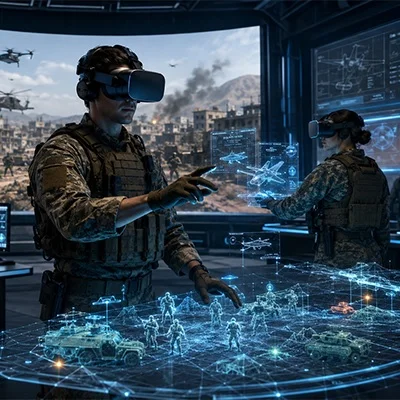
Unlike traditional simulators designed for individual equipment or aircraft, today's immersive platforms connect soldiers, commanders, pilots, naval operators, intelligence analysts, and cyber specialists into synchronized virtual missions. Every participant experiences the same dynamic battlefield while performing their unique operational role.
This interconnected approach allows defense organizations to evaluate decision-making, communication, coordination, and tactical execution simultaneously.
Rather than practicing isolated skills, personnel train for complete missions.
Beyond Virtual Reality: Building Intelligent Military Ecosystems
When discussing VR Military Training, the conversation often focuses on virtual reality headsets. However, immersive defense training extends far beyond VR goggles.
Modern simulation ecosystems integrate multiple technologies, including:
- Virtual Reality (VR)
- Augmented Reality (AR)
- Mixed Reality (MR)
- Artificial Intelligence
- Digital Twins
- Motion Capture
- Biometric Monitoring
- Cloud-Based Simulation Networks
- Real-Time Battlefield Analytics
These technologies create highly responsive learning environments where every trainee's actions influence how scenarios unfold.
For example, AI can modify enemy behavior based on trainee performance, forcing participants to continuously adapt instead of memorizing scripted exercises.
This creates significantly more realistic learning experiences than conventional simulator-based instruction.
Immersive Military Simulation Platforms Redefining Training
The latest Immersive military simulation platforms are designed around one central objective—creating realistic operational experiences that improve decision-making under pressure.
Instead of static scenarios, these systems introduce evolving mission variables such as:
- Civilian movement
- Weather changes
- Equipment failures
- Communication breakdowns
- Drone surveillance
- GPS denial
- Electronic interference
- Unexpected enemy tactics
Every exercise becomes unique.
As military personnel repeat training under different conditions, they develop adaptability rather than predictable responses.
This prepares forces for uncertainty—the defining characteristic of modern warfare.
AI Is Becoming the New Battlefield Instructor
Artificial intelligence has transformed simulation from scripted training into adaptive learning.
Rather than simply recording outcomes, AI continuously evaluates participant behavior throughout each exercise.
It can identify:
- Tactical weaknesses
- Communication delays
- Leadership effectiveness
- Situational awareness
- Decision-making speed
- Team coordination
- Mission efficiency
Instead of waiting until exercises conclude, AI provides immediate performance insights that instructors can use for targeted coaching.
Future Advanced defense training systems increasingly employ machine learning models capable of generating new mission scenarios based on previous trainee performance.
Every training session becomes progressively more challenging and personalized.
Virtual and Augmented Reality Military Training Creates Safer Learning Environments
Live-fire exercises remain essential, but not every high-risk scenario can be recreated safely.
This has accelerated investments in Virtual and augmented reality military training, allowing personnel to experience hazardous environments without exposing themselves to unnecessary danger.
Examples include:
Urban Combat
Soldiers navigate dense urban environments featuring civilians, hostile forces, damaged infrastructure, and rapidly changing threats.
Aircraft Emergencies
Pilots practice catastrophic system failures that would be impossible to recreate safely in actual aircraft.
Naval Operations
Crews rehearse onboard emergencies, missile attacks, flooding, and damage control procedures.
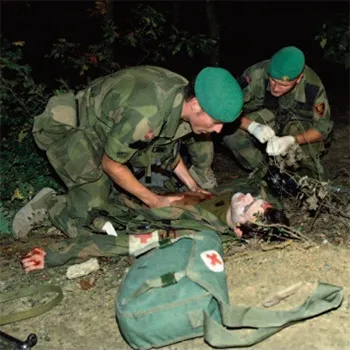
Medical Response
Combat medics repeatedly practice trauma treatment under simulated battlefield conditions.
Chemical, Biological, Radiological, and Nuclear (CBRN) Incidents
Personnel experience hazardous response scenarios without exposure to real contaminants.
The result is greater preparedness while significantly reducing operational risk.
Combat Simulation Technologies Now Include Entire Battle Networks
Modern Combat simulation technologies have evolved beyond individual simulators.
Today's platforms create synchronized digital battle networks where multiple units participate simultaneously.
A single exercise may include:
- Infantry units
- Tank operators
- Fighter aircraft
- Naval vessels
- Drone operators
- Satellite intelligence
- Cyber defense teams
- Command headquarters
Every participant interacts within the same operational environment.
This enables commanders to evaluate joint-force coordination rather than isolated unit performance.
For multinational defense alliances, these integrated simulations also improve interoperability between allied forces before actual deployments.
Data Is Becoming the Most Valuable Training Asset
Every simulated mission generates enormous amounts of operational data.
Rather than relying solely on instructor observations, modern Defense Training Systems automatically capture thousands of performance metrics throughout each exercise.
These include:
- Reaction times
- Target acquisition speed
- Communication effectiveness
- Resource utilization
- Threat identification accuracy
- Tactical movement
- Mission completion rates
- Stress indicators
Advanced analytics transform this information into measurable learning outcomes.
Instead of subjective evaluations, defense organizations gain objective performance benchmarks that support continuous improvement.
Training becomes increasingly evidence-based rather than experience-based alone.
Cloud-Connected Simulation Enables Global Collaboration
Military operations increasingly involve multinational coalitions operating across different geographical regions.
Cloud-enabled Defense Simulation Platforms allow geographically separated forces to train together without requiring physical deployment.
Personnel located on different continents can participate in synchronized exercises while sharing identical operational environments.
This significantly reduces:
- Travel expenses
- Equipment transportation
- Training preparation time
- Scheduling conflicts
More importantly, coalition partners develop common operational procedures before participating in real-world missions.
Digital Twins Are Enhancing Equipment Familiarity
Digital twin technology is transforming equipment training across defense organizations.
Rather than waiting for physical platforms to become available, personnel interact with highly accurate digital replicas of:
- Fighter aircraft
- Naval vessels
- Armored vehicles
- Missile systems
- Radar installations
- Communication infrastructure
These virtual assets replicate operational behavior in real time.
Engineers, maintenance teams, and operators can practice inspections, repairs, diagnostics, and emergency procedures before working on actual equipment.
The result is faster technical proficiency and reduced maintenance errors.
Personalized Learning Is Replacing Standardized Instruction
Every military professional learns differently.
One soldier may require additional tactical decision-making practice, while another may need communication improvement.
AI-powered Advanced virtual simulation systems for modern defense forces increasingly personalize training pathways for individual learners.
Instead of following identical lesson plans, personnel receive exercises specifically designed around their performance history.
This adaptive approach accelerates competency development while improving knowledge retention.
Training becomes learner-centric without sacrificing operational standards.
Cyber and Electronic Warfare Are Becoming Core Simulation Components
Modern military operations extend far beyond physical combat.
Simulation platforms now integrate cyberattacks, communication disruptions, GPS interference, electronic jamming, and information warfare into training exercises.
Commanders must make operational decisions while simultaneously responding to digital threats.
This holistic approach prepares defense personnel for multi-domain warfare where cyber resilience is as critical as battlefield tactics.
Sustainability Is Emerging as an Unexpected Advantage
Large-scale military exercises require significant fuel consumption, ammunition, transportation, and logistical planning.
Immersive simulations dramatically reduce environmental impact by minimizing resource-intensive training events while preserving operational realism.
Although live exercises remain irreplaceable, simulation enables organizations to reserve physical assets for mission-critical training while conducting routine practice digitally.
This improves sustainability alongside operational efficiency.
The Future-Ready Military Training Environment
The next generation of Future-ready military training platforms using immersive technologies will become increasingly autonomous and interconnected.
Emerging capabilities are expected to include:
- AI-generated mission planning
- Autonomous adversary behavior
- Haptic feedback suits
- Brain-computer interface experimentation
- Voice-controlled mission environments
- Real-time language translation for coalition exercises
- Persistent virtual battlefields
- Quantum-enhanced simulation processing
These innovations will make training environments nearly indistinguishable from real operational scenarios.
Rather than preparing for yesterday's conflicts, military organizations will continuously rehearse emerging threats before they materialize.
Human Performance Remains the Ultimate Objective
Despite rapid technological advancement, immersive simulation is not intended to replace military instructors or live operational experience.
Instead, technology amplifies human capability.
Experienced trainers remain responsible for developing leadership, ethics, judgment, discipline, and strategic thinking—qualities no simulation can fully replicate.
Immersive technologies simply provide more opportunities to practice those qualities under increasingly realistic conditions.
This balance between digital innovation and human expertise is becoming the defining characteristic of modern military education.
Conclusion
As defense organizations navigate increasingly complex operational environments, immersive simulation has become a cornerstone of military preparedness. The evolution of Defense Training Systems is enabling armed forces to move beyond conventional instruction toward intelligent, adaptive, and highly realistic training experiences that better reflect the realities of modern warfare.
From AI-powered Military Simulation environments and next-generation VR Military Training to integrated Defense Simulation Platforms, the focus has shifted from simply teaching procedures to cultivating faster decision-making, stronger collaboration, and mission-ready performance. Advanced Immersive military simulation platforms and Combat simulation technologies now allow forces to rehearse complex, multi-domain operations with unprecedented realism while reducing costs, improving safety, and accelerating skill development.
As innovation continues to reshape defense preparedness, Advanced defense training systems, Virtual and augmented reality military training, and Advanced virtual simulation systems for modern defense forces will play an increasingly critical role in ensuring operational readiness. The future belongs to Future-ready military training platforms using immersive technologies—solutions that empower defense organizations to prepare personnel for evolving threats with greater precision, resilience, and confidence than ever before.
 Our Services
 Media Pack Download
 Newsletters
 Industrial Events