

Command and Control Systems for Multi-Domain Operations
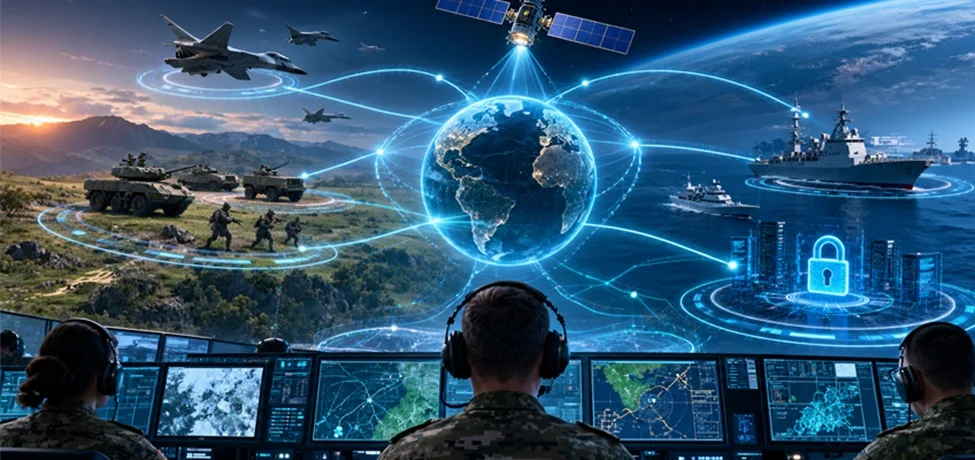
A practical guide to how modern defence forces connects land, sea, air, space and cyber into one decision-making network
Quick answer: what are command and control systems for multi-domain operations?
Command and control systems for multi-domain operations are a connected set of software, networks, sensors and decision tools that lets commanders see, decide and act across land, sea, air, space and cyber at the same time, using one shared picture of the battlefield. Instead of each service running its own isolated system, an integrated C2 system fuses data from all of them so decisions are made faster and with fewer blind spots.
That's the short version. The rest of this guide explains why it matters, how it works, and what to look for if you're evaluating one.
Why single-domain command systems are no longer enough
Not long ago, a battle could be managed largely within one domain. An armoured brigade fought on land. A fleet fought at sea. Air forces owned the sky. Coordination happened, but often slowly, through liaison officers, radio nets and carefully timed plans.
That world has gone. A single drone strike today might depend on satellite imagery, an electronic warfare screen, a cyber operation to blind an air defence node, and a land unit to exploit the gap. All within minutes.
When each of those actors reports through a different military command system, something predictable happens: information arrives late, gets duplicated, or never arrives at all. The commander who is supposed to connect the dots is stitching together five screens and a phone call.
This is the gap that multi-domain command and control systems exist to close.
How do multi-domain C2 systems actually work?
Strip away the jargon and every modern C2 system does four jobs.
1. Collect. Data flows in from radars, drones, satellites, ground sensors, signals intelligence, ships, aircraft and soldiers' own devices.
2. Fuse. Software correlates all of it into a single operational picture. If three sensors report the same vehicle, the system recognises it as one target, not three.
3. Decide. Commanders and staff use that picture, increasingly supported by analytics and AI-assisted recommendations, to choose a course of action.
4. Act and assess. Orders go out to the right unit or weapon system, and the results feed straight back into step one.
Military planners often call this loop sense, decide, act. The faster and cleaner the loop, the harder you are to beat. Multi-domain C2 is really an attempt to shorten that loop without losing accuracy.
Core building blocks of integrated defence command systems
When people talk about integrated defence command systems, they usually mean a stack of several layers working together:
• Common operational picture (COP): one shared, live map that every echelon can see, filtered to what each user needs.
• Battlefield management systems (BMS): tactical tools that track friendly forces, share positions, and push orders and reports down to platoon and vehicle level.
• Communications backbone: resilient radio, satellite and mesh networks that keep working when links are jammed or degraded.
• Data fusion and analytics: the engine that merges sensor feeds and flags what matters.
• Cyber and electromagnetic awareness: visibility into the network and spectrum, not just the physical terrain.
• Interoperability layer: open interfaces and standards so different systems and allied partners can plug in.
Skip any one of these and the whole thing wobbles. A beautiful dashboard is useless without a communications network that survives jamming.
Battlefield management systems vs. higher-level C2: what's the difference?
People often mix these up, so here is the simple distinction.
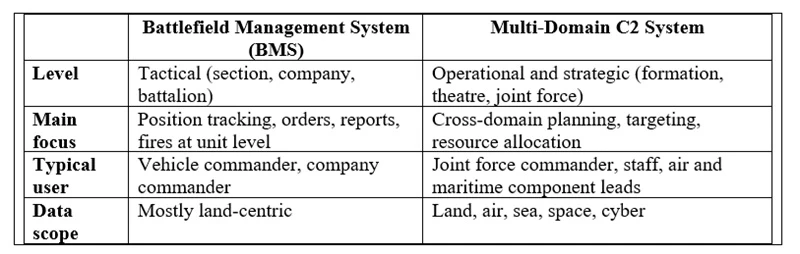
They are not rivals. A good defence C2 system treats the BMS as the tactical edge of a larger network, so what a section commander sees at the front connects to what the theatre commander sees at headquarters.
What makes joint operations command systems hard to get right?
Building one is less about technology and more about everything around the technology. These are the issues that most often cause programmes to stall.
Legacy systems. Most forces already operate dozens of older platforms, each with its own data formats. Ripping them all out is unrealistic, so new joint operations command systems usually have to integrate with what exists.
Service culture. Army, navy and air force have different doctrines, vocabularies and priorities. Technology can connect them, but only if the joint force agrees on shared procedures.
Data overload. More sensors don't automatically mean better decisions. Without good filtering, commanders drown in information. The best systems show less, but show the right thing.
Contested networks. In a real conflict, the adversary will jam, spoof and attack your communications. A C2 system that works only in perfect conditions is a demo, not a capability.
Trust in automation. AI-assisted recommendations speed things up, but commanders need to understand why the system suggests something. Explainability matters as much as speed.
Real-world direction: where modern forces are heading
Around the world, defence forces are reorganizing around this idea. The United States is pursuing Joint All-Domain Command and Control (JADC2), NATO has been developing its own multi-domain operations concept, and many other nations are building joint structures and networked architectures of their own. In India, the move toward integrated theatre structures reflects the same underlying logic: forces fight as one team, so they need to command as one team.
The common thread is that no one is buying a single product. They are building an ecosystem in which sensors, shooters and decision-makers share information across services and, increasingly, across allied nations.
What to look for in integrated C2 solutions for modern defence forces
If you're a defence planner, procurement officer or industry analyst comparing options, these questions separate serious systems from slideware:
1. Is it open and modular? Can new sensors, effectors or applications be added without rebuilding the whole system?
2. Does it work in degraded conditions? What happens when bandwidth drops or links are cut?
3. How does it handle security? Look for zero-trust principles, strong encryption, and multi-level security that lets different classification levels coexist.
4. Can it scale? From a single vehicle to a full theatre, with the same data model.
5. How easily can allies connect? Interoperability with partner forces should be designed in, not bolted on.
6. Is it usable under stress? If operators need a manual to read the screen, it fails. Good design is a battlefield feature.
7. What is the sustainment plan? Software needs continuous updates. Ask how upgrades are delivered and how long they take.
8. Is there a clear path for AI and automation? Not as a gimmick, but as a controlled, auditable support to human decision-making.
The human element nobody should skip
It's tempting to treat C2 as a pure technology problem. It isn't. The best system in the world fails if operators are poorly trained, if staff procedures don't match the tools, or if commanders don't trust what they're seeing.
Forces that get this right tend to do three things well: they train with the system constantly, they test it in realistic and messy exercises, and they involve operators in the design from the start. Technology sets the ceiling. People determine how close you get to it.
Frequently asked questions
What does C2 stand for in the military?
C2 stands for command and control: the authority a commander exercises over forces, and the systems and processes used to direct them. You may also see C4ISR, which adds communications, computers, intelligence, surveillance and reconnaissance.
What is the difference between C2 and multi-domain C2?
Standard C2 may operate within one service or domain. Multi-domain C2 connects land, sea, air, space and cyber into a single decision environment, so operations in one domain can support and shape operations in another.
What is a common operational picture?
It is a shared, real-time display of the battlespace, showing friendly forces, adversary activity and the environment, so every commander works from the same facts.
Are battlefield management systems part of C2?
Yes. A BMS is the tactical layer of a wider C2 architecture, focused on tracking and coordinating forces at the unit level.
Why is interoperability so important?
Modern operations are joint and often allied. Systems that cannot exchange data cost time, and time costs lives.
Will AI replace commanders?
No. AI is being used to filter data, spot patterns and suggest options. Accountability and final decisions stay with human commanders.
Final thoughts
Multi-domain operations are not a future concept. They are how conflicts are already being fought. The forces that adapt best will be those that can see clearly, decide quickly and act together, and that comes down to the quality of their command-and-control systems.
The technology matters. But so do open standards, resilient networks, realistic training, and a culture that treats the joint force as one team. Get all of those right, and a multi-domain command and control system stops being an IT project and becomes a genuine advantage.
 Our Services
 Media Pack Download
 Newsletters
 Industrial Events