


How AI-Driven Targeting Systems are Enhancing Multi-Domain Surveillance and Fire Control Capabilities
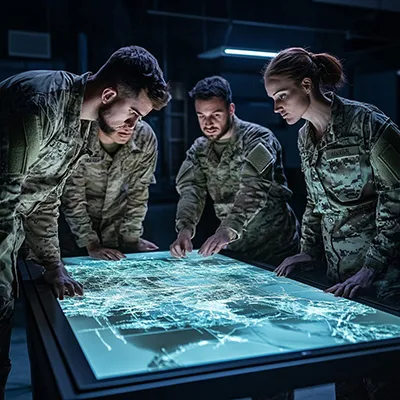
The use of AI-based target systems in the latest defense frameworks is transforming multi-space monitoring and fire control. With the help of the combat AI systems, the military forces have been gaining real-time situational awareness, informed threat detection, and AI-optimized targeting capabilities, guaranteeing excellent results in any area regardless of the current situation.
The Rise of AI in Military Warfare
Terrain no longer defines the battle field. As the battle field heightens both in physical and cyber space, conventional war tactics are fast giving way to AI-enabled weapons system and AI-driven defense surveillance systems. In electronic surveillance flights to real-time battlefield actions, combat AIs are already defining the playbook of the future battle fields.
Whether or not to embrace the use of artificial intelligence in military activities is no longer a question that defense planners are asking; rather it is how soon they can incorporate the use of artificial intelligence in their military targeting and fire control systems without affecting the integrity of their operations and ethics.
Why AI-Driven Targeting Systems are Mission-Critical
Milliseconds can change the outcome of success and catastrophic failure in the high-intensity combat zone. The benefits of AI on targeting systems are a game changer in speed and accuracy to automate the detection of threats, their classification and engaging them.
In contrast to the legacy systems that are very manual oriented, the automated targeting systems used in armed forces can delve simultaneously in tracking of dozens of targets in various domains. They combine sensor measurements, satellite pictures, and battlefield intelligence to rank threats in a real-time. The result? Rapid targeting using AI that virtually eliminates collateral damage as well as optimum use of scarce resources.
Hypothetically speaking, the following situation: An extremely fast missile has been noticed entering a domain of conflict. The. Through AI on military fire control system, however, the threat is directly analyzed, the level of threats has alarming time evaluated, and an intercept decision made, all in a duration of seconds.
Multi-Domain Warfare: A New Complexity
The contemporary warfare is conducted within five domains that are closely related to each other including the land, air, sea, space and cyberspace. It is no longer enough to dominate in any of the areas. The military superiority currently relies on multi-domain operation that requires coordinated decision-making and surveillance.
This is where the issue of the multi-domain operation and artificial intelligence comes in play. AI algorithms consume and operationally analyze the huge amounts of data in any field, and detect what would be interpreted by human analysts in hours, perhaps days. Such data convergence equips commanders with a consistent seamless picture of operations.
In various ways, AI-equipped surveillance systems aimed at the defense presented the possibility of flying a drone into the opposition region and the images sent to naval vessels and ground further matched against capture imagery by satellite. This interoperability is the basis upon which the future approach to combat is based.
How AI Enhances Precision in Military Fire Control Systems
There can never be a better precision check than the military fire control system that uses AI in connecting missiles, handing over artillery or carrying out an airstrike.
The idea behind the increase in precision of military fire control systems through AI can be described using a number of mechanisms:
- Trajectory optimization: The AI models determine the most efficient route of munitions during ever-changing conditions.
- Weather compensation: Wind, speed, humidity, etc., which are used to adjust targeting by AI.
- Target behavior prediction: Through the detection of enemy movement patterns AI predicts the movements.
The effect is high level of accuracy that reduces highly incidents of friendly-fire and cause of missions’ failure.
Market Dynamics and Defense Investments
To get an idea of the magnitude and intensity in the integration of AI in defense, it is noteworthy to take global trends in terms of investment.
| Region | Projected AI Defense Spending by 2028 | Focus Areas |
| United States | $30 Billion | Autonomous weapons, AI targeting |
| China | $25 Billion | Surveillance AI, cyber warfare |
| EU Nations | $15 Billion | Multi-domain operations, AI analytics |
| India | $8 Billion | Border surveillance, UAV targeting |
The increase in expenditure also indicates the increasing interest in the weapons systems and targeting systems that have AI capabilities and are utilized by armed forces. Defense companies and military research institutes are racing to create proprietary platforms that can incorporate AI into military targeting for real-time decision support.
Transforming Intelligence, Surveillance, and Reconnaissance (ISR)
ISR - Intelligent Surveillance and Reconnaissance is at the core of all combat strategies. Artificial intelligence equipped surveillance systems are rapidly becoming substitutes or supplements to traditional ISR systems such as ground sensors, and manned reconnaissance aircraft, used by the defense forces.
AI is very important in:
- Autonomous drone surveillance: The use of swarm drones with combat AI would be able to watch borders and conflict zones independently.
- Satellite data processing: Using AI, the analysis of images, which used to take hours, finds previously secret encampments of the enemy or mobile missile launchers.
- Cyber-intelligence gathering: AI monitors and forecasts online attacks on cyberspace.
In the case of improving ISR capabilities, AI-enabled targeting systems guarantee visualization of the threats in real-time and, therefore, provide a high level of responsive and proactive command and control.
From Reactive to Predictive Combat: The AI Advantage
Artificial intelligence in multi-domain operations is the opportunity to transform warfare into a predictive state, which makes it one of the most compelling strategies of the artificial intelligence. Rather than having threats in front of them, the AI algorithms are used to analyze historical information, behavioral dynamics, and intelligence on behalf of predicting hostile movements.
Consider border patrol situations, as an example. On the defense part using AI-based surveillance systems, ground sensors identify anomalous movement. The same is then cross referenced with satellite heat signatures and historical intrusion patterns to be able to forecast whether or when a breach is likely to take place. The military forces are sent out even before the menace arises.
As the AI in targeting brings a predictive element in military operations, they are potentially able to make preventive action, saving lives and resources.
The Human-AI Collaboration: Not Replacing, but Enhancing
It is a widespread assumption that the AI combat systems are created to substitute people as decision-makers. The situation is just the reverse. The new era is in Human-AI cooperation. As an effective aid, AI should process the information, point out irregularities, and suggest updates, but the decision should be made by educated workers.
Take the example of AI in a military fire control system: AI might propose the optimal artificial path of the trajectory of the artillery, but it is the humans in control of the situation that will determine whether that advice is right in the given situation due to situational awareness and the rules of engagement. This collaboration provides that AI-based targeting mechanisms do not go against the ethics of the military or situational awareness.
Integration Challenges: Ethics, Interoperability, and Trust
Like at any other battle, there are issues that must be traversed with the promise of AI-powered weapons systems:
- Ethical dilemmas: Can the AI be permitted to make killing judgments at the autonomous level? A majority of the military theories posit human control.
- Data bias and adversarial AI: Any AI algorithm that is based on incomplete, biased, and inaccurate data are thumbs down. Even AI models had their weaknesses which could be used against them by enemies.
- Interoperability: It is usually difficult and expensive to integrate new automated targeting systems in armed forces with old assets.
- Cybersecurity threats: With increased attacks using AI-based surveillance solutions to safeguard them, the likelihood of being hacked and destabilized by cyberattacks will also increase.
Although these issues are increasingly becoming prominent, the sheer exodus of support towards combat AI systems is quite encouraging, and indeed these concerns are being dealt with by means of extreme testing conditions, global standards, and AI ethics codes.
Future Outlook: Toward Autonomous Combat Ecosystems
The next state of military activity is possibly on the shoulders of entirely autonomous combat ecosystems. Consider flotillas of the autonomous systems drones, tanks, ships, and so on, acting with a single-minded coordination guided by a centralized AI brain. The units would use AI in military targeting, AI in fire control systems, and AI-based surveillance systems to defense to detect the threats, relay strategic information, and perform missions without direct human intervention.
At these ecosystems:
- Robotic weapon control systems do not wait in line to decide. Automated targeting systems in armed forces attack without delay in decision-making processes.
- The AI can learn incessant loops as they take place in the course of the battle itself.
The tactical reality is fast catching up with what appeared to be mere science fiction in the past.
Conclusion: Redefining Military Superiority
The age of digital warfare has started - and the AI-based targeting systems lead the way. They do not simply make weapons smarter, but change the idea of something being prepared, proactive, and precise in the environment of modern battle situations.
The influence of combat AI systems runs far and deep, including increasing the accuracy of targeting through AI, all the way to changing the face of AI used in tactical fire control.
Nations, who invest in them responsibly undertake these capabilities, will not only gain strategic leverage, they will make their own history of defense.
As the world is becoming more competitive and technologically advanced, artificial intelligence in multi-domain operations is no longer a competitive advantage, but the new meaning of defense readiness.
 Our Services
 Media Pack Download
 Newsletters
 Industrial Events




.webp)