

Training & Simulation Systems: Driving Military Readiness in 2026
Key Takeaways (Quick Answer)
- Military training and simulation systems use virtual, constructive, and live environments to prepare forces for combat without the cost and risk of real-world exercises.
- In 2026, the biggest shifts are AI-driven adversaries, cloud-connected training, and blended live-virtual-constructive (LVC) environments.
- The goal is faster skill-building, lower cost per training hour, and more realistic rehearsal for complex, multi-domain operations.
Why Are Training and Simulation Systems So Important Right Now?
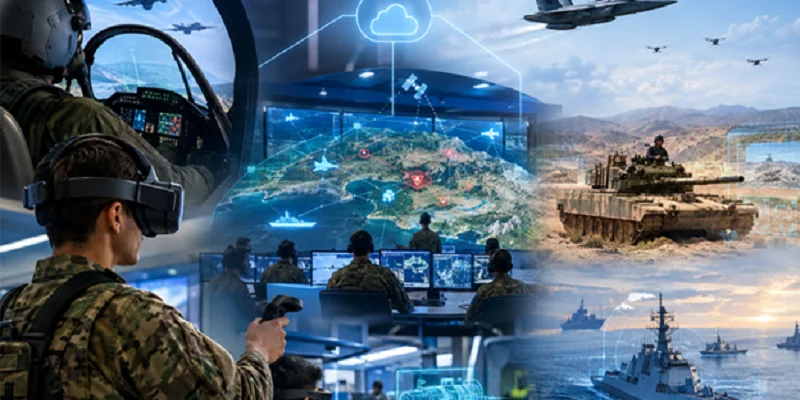
Imagine a fighter pilot rehearsing a missile evasion, a tank crew practicing urban navigation, and a naval bridge team managing a crowded strait. All three can happen on the same day, in the same networked scenario, without burning a drop of fuel.
That's what modern military training and simulation systems make possible.
Real exercises are still vital, but they are expensive, weather-dependent, and hard to repeat. Live-fire ranges are limited, and some threats, like advanced electronic warfare or coordinated drone swarms, can't be safely recreated in the field. Simulation fills those gaps.
In 2026, readiness is no longer only about having equipment. It's about how quickly people can learn, adapt, and perform together under pressure. That's why defence forces around the world are investing heavily in advanced simulation technology for military training.
What Is Military Simulation? (Simple Definition)
Military simulation is the use of computer-generated environments, models, and hardware to recreate battlefield conditions for training, planning, and testing. Trainees interact with realistic scenarios, and the system responds to their decisions the way a real situation would.
Simulation generally falls into three categories:
- Live simulation: Real people using real equipment, often with sensors and laser-based systems to track hits and outcomes.
- Virtual simulation: Real people operating simulated equipment, such as a flight simulator or driving trainer.
- Constructive simulation: Simulated people operating simulated equipment, often used for staff exercises and large-scale wargames.
The real power comes when these three are combined, which brings us to the biggest trend in the field.
How Do Live-Virtual-Constructive (LVC) Environments Work?
LVC training links all three simulation types into one shared scenario. A pilot flying a real aircraft can see virtual enemy jets on their display. A commander in a headquarters can direct computer-generated units alongside real ones. A ground team can train against a mix of live role-players and virtual opponents.
Why does this matter? Because modern conflict is not fought in one domain. Land, air, sea, space, and cyber operations overlap, and forces need to rehearse that complexity together.
For defence training systems, LVC delivers three clear benefits:
- Scale: You can add hundreds of virtual participants without moving a single vehicle.
- Safety: Dangerous or restricted scenarios can be practiced with zero physical risk.
- Repeatability: A scenario can be run, paused, reviewed, and replayed until the lesson sticks.
What Technologies Are Powering Military Training Simulation in 2026?
The tools have matured a great deal. Here are the technologies shaping military training technology today.
1. Artificial Intelligence and Adaptive Adversaries
Older simulations relied on scripted enemies. Once trainees learned the pattern, the challenge disappeared. AI-driven opponents behave differently each time. They react, flank, retreat, and exploit mistakes. This makes training feel less like a video game and more like facing a thinking opponent.
AI also personalizes instruction. Systems can spot where an individual trainee struggles, such as target identification or radio discipline, and adjust the next scenario to focus on it.
2. Virtual and Augmented Reality
Headsets and mixed-reality tools have become lighter, sharper, and more affordable. Soldiers can walk through a virtual village, practice room clearing, or inspect a virtual engine before touching the real one. Augmented reality overlays instructions or threats onto the real world, blending combat training systems with live environments.
3. Digital Twins
A digital twin is a virtual replica of a real asset, such as an aircraft, ship, or vehicle. In training, it lets crews practice on an exact copy of their platform, including its quirks, sensors, and limitations. It also helps maintenance teams rehearse repairs before they ever open a panel.
4. Cloud and Networked Training
Cloud-based architectures let units in different locations join the same exercise. A crew in one country can train alongside allies elsewhere, which is especially valuable for coalition operations where interoperability decides outcomes.
5. Data Analytics and After-Action Review
Every action in a simulation can be recorded. Instructors can replay a scenario from any angle, measure reaction times, and show exactly where a decision went wrong. This turns training from "we think we did well" into measurable, evidence-based improvement.
What Are the Main Types of Military Training Systems?
If you're comparing military training systems, here's a quick guide to the major categories:
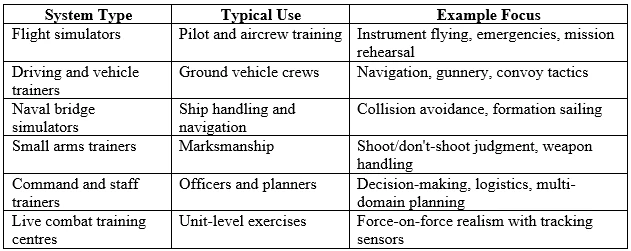
Each of these can operate on its own or plug into a larger networked environment.
How Does Simulation Improve Military Readiness?
This is the question decision-makers ask most, and the answer comes down to four things.
1. Faster skill acquisition. Trainees get more repetitions in less time. A pilot can practice a rare emergency dozens of times in a week, something that would be unthinkable in a real aircraft.
2. Lower cost per training hour. Operating fighter jets, warships, or armoured vehicles is costly. Simulators don't eliminate live training, but they reduce how much of it is needed for basic and intermediate skills, and they preserve equipment life.
3. Safer preparation for high-risk tasks. Failure in a simulator is a lesson. Failure in the field can be a tragedy.
4. Mission rehearsal. Units can rehearse a specific operation using terrain data and intelligence before deployment, arriving with a shared mental picture of what to expect.
What Challenges Do Defence Simulation Programmes Face?
It would be unfair to paint an entirely rosy picture. Even the best defence simulation programmes run into real obstacles:
- Realism versus cost. High-fidelity systems can be expensive to build and maintain.
- Interoperability. Systems from different vendors or nations don't always talk to each other easily. Open standards and common architectures are still a work in progress.
- Cybersecurity. Networked training environments must be protected as carefully as operational systems.
- Training transfer. A simulator is only useful if skills carry over to real operations. Continuous validation is essential.
- Human factors. Technology cannot replace good instructors, strong doctrine, and a culture that values training.
The most successful programmes treat simulation as one part of a balanced training pipeline, not a replacement for real-world experience.
What Does the Future Look Like Beyond 2026?
Several directions stand out for military simulation technology:
- Multi-domain synthetic environments that include space and cyber operations alongside land, sea, and air.
- Generative AI that builds scenarios, terrain, and role-players on demand, cutting the time needed to design an exercise.
- Wearable and biometric feedback that tracks stress, fatigue, and cognitive load, helping instructors understand not just what a trainee did, but how they handled pressure.
- Portable, deployable trainers that let forces keep practicing in remote or forward locations.
The direction is clear: training is becoming more continuous, more personalized, and more connected to real operations.
Frequently Asked Questions
What are military training and simulation systems?
They are integrated tools, including software, hardware, and networks, that recreate operational conditions so personnel can practice skills, tactics, and decision-making safely and repeatedly.
Why is simulation used in military training?
Because it reduces cost and risk, allows unlimited repetition, and makes it possible to rehearse scenarios that are too dangerous, rare, or complex to recreate in real life.
What is the difference between live, virtual, and constructive simulation?
Live uses real people and real equipment, virtual uses real people with simulated equipment, and constructive uses simulated people and equipment. Combining them is called LVC training.
Can simulation replace live training completely?
No. Simulation complements live training. Real-world exercises remain essential for physical conditioning, equipment handling, and testing under genuine environmental stress.
How is AI used in defence training systems?
AI powers adaptive enemy behaviour, personalizes lessons to individual trainees, automates scenario generation, and supports faster after-action analysis.
Final Thoughts
Military readiness in 2026 depends less on how much equipment a force owns and more on how well its people are prepared to use it together. Advanced simulation technology for military training is now central to that preparation. It shortens learning curves, protects lives, and lets forces rehearse the missions they hope they'll never have to fly, sail, or drive.
For defence organizations, the question is no longer whether to invest in simulation, but how to integrate it wisely with live training and real-world doctrine.
 Our Services
 Media Pack Download
 Newsletters
 Industrial Events