


Precision Targeting Systems for UAVs and Aircraft in Modern Defense Operations
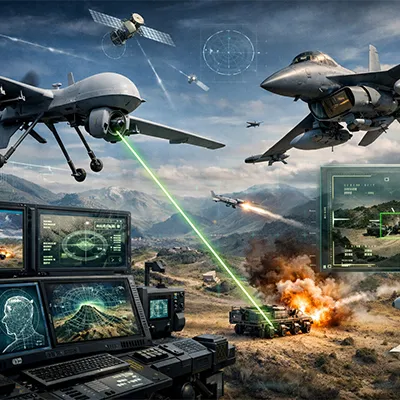
Introduction: Precision as a Strategic Imperative in Defense Aviation
The contemporary operations of defense are characterized by precision, speediness, and information dominance. Due to the increased complexity of the military environment (to the point of being multi-domain), the capability to detect, follow and eliminate targets with minimal civilian harm is no longer a strategic benefit but a strategic requirement. UAV and military aircraft precision targeting systems are now at the heart of this change, leading to the defense forces being able to undertake intelligence-led, high precision missions over the disputed airspace.
In the field of surveillance and reconnaissance endeavours as well as in strike operations and border security, UAV precision targeted systems and sophisticated targeting technology of the military aircraft air and land vehicle is transforming the manner in which the contemporary defense forces design and execute their operations. These systems combine sensors, data merging engines, artificial intelligence and autonomous decision support frameworks to provide more accuracy and operational efficiency than ever before.
Defining Precision Targeting Systems in Defense Aviation
Precision targeting systems are hardware-software architectures that are meant to locate, monitor, prioritize, and attack targets precisely. Within the framework of the military UAV systems and manned aircraft, these systems can be considered mission-critical enablers that mediate between intelligence, surveillance, reconnaissance and strike capabilities.
In comparison to legacy targeting solutions that were based on manual interpretation and separated sensor feeds, new generation airborne targeting systems of defense forces are networked ecosystems. They integrate electro-optical and infrared cameras, synthetic aperture radar, laser designation devices, GPS-guided firing, and artificial intelligence-based analytics to assist in making real-time decisions in dynamic battlefield scenarios.
Evolution of Target Acquisition Systems for Drones and Aircraft
Drones have developed a much improved target acquisition systems within the last 20 years due to the asymmetric warfare, counterterrorism operations, and contested border environments. The initial UAV platforms were essentially reconnaissance tools that had a limited time to detect and a poor sensor resolution. The current military UAV systems are fitted with advanced defense-target systems that have self-recognition of targets and laser-guided engagements.
Three factors have contributed to this evolution: the development of miniaturisation of sensors, the increased onboard processing power, and the implementation of AI-oriented targeting systems. All these improvements have helped UAVs to become not only passive observers, but also players in precision strike missions, in addition to assisting manned aircraft by cooperating in targeting and exchanging data.
Core Technologies Powering UAV Precision Targeting Systems
The key part of the precision targeting systems of UAVs is a complex set of sensing, computation, and communication technologies. The electro-optical and infrared imaging systems are capable of operating during the day or night and this means that the targets can be recognized in different environmental conditions. Synthetic aperture radar is used to improve the situational awareness of the detection of targets in clouds, smoke, and hostile weather.
The targeting and designation technologies are based on lasers, and this technology allows precision-guided targeting technology to mark targets with laser-guided munitions. These also are becoming more coupled to GPS and inertial navigation systems to provide accuracy even when in GPS-denied or electronically contested modes. Secure data links help UAVs and aircrafts to communicate the targeting data in real-time to command centers and allied platforms to facilitate coordinated actions.
Role of AI-Driven Targeting Systems in Modern Warfare
Targeting systems that are AI-driven have become one of the transformational factors in the contemporary defense aviation. These systems can identify patterns automatically using machine learning algorithms on sensor data, classify objects and prioritize threats with the speed and consistency these systems can find data patterns, outperform human capabilities.
In UAV precision targeting, AI is capable of target recognition in real-time, which limits the workload and decision-making latency of the operator. Independent control of UAVs enables targets to be tracked, the mission to be adjusted according to the dynamic mission parameters and options to engage the target recommended with human operators remaining in the loop. In defense forces that work in high-tempo environments, this capability is important to increase mission effectiveness and survivability.
Autonomous Targeting for UAVs: Balancing Automation and Control
UAV autonomous targeting is an important direction in the efficiency of operations, especially in the areas of long-duration and swarm operations. Such systems rely on onboard AI to control target tracking, sensor optimization and engagement planning with little human interventions.
Nevertheless, the current defense principles focus more on the controlled autonomy than the complete automation. Human-in-the-loop and human-on-the-loop systems can do both, meet rules of engagement and international law and still enjoy speed and accuracy brought by AI. The balance will be crucial in ensuring the accountability, trust and ethical governance in superior defense targeting systems.
Advanced Targeting Technologies for Military Aircraft
Although the UAVs predominate when speaking about unmanned precision strike, the military aircraft advanced targeting, still remains an important part of any military operation in the current times. Multi-sensor targeting pods, network-centric targeting architectures, and AI-assisted mission computer are being fit on fighter jets, surveillance aircraft, and attack helicopters.
These systems empower the aircraft to act either as network links in a larger defense ecosystem. Man-controlled aircraft can be provided with the ability to share the gathered data produced by UAVs in real time, which allows them to engage in mutual cooperation strategies. Such an overlap between manned and unmanned targeting capabilities is one of the distinguishing characteristics of next-generation airborne targeting capabilities by military forces.
Precision-Guided Targeting Technology in Multi-Domain Operations
The technology of precision-guided targeting is no longer limited to air to ground operations. Through multi-domain operations, the target systems are required to coordinate air, land, sea, space, and cyber domain operations. UAV precision targeting systems are part of this in that they offer persistent surveillance, quick validation of targets and fidelity information streams.
Advanced defense targeting systems allow co-ordinated efforts across various units and domains by combining with the command-and-control platforms and battlefield management systems. This is specifically important in sophisticated situations like urban warfare, sea security and border patrol.
Industry Snapshot: Key Capabilities across Targeting Platforms
| Capability Area | UAV Precision Targeting Systems | Military Aircraft Targeting Systems |
| Sensor Integration | EO/IR, SAR, laser designation | Multi-sensor pods, radar fusion |
| AI Enablement | Real-time target recognition | AI-assisted threat prioritization |
| Autonomy Level | Semi-autonomous to autonomous | Operator-assisted automation |
| Network Integration | Secure datalinks, swarm coordination | Joint force data sharing |
| Mission Profile | ISR, precision strike, loitering ops | Air superiority, deep strike |
Defense Procurement and Industrial Implications
Regarding B2B and defense industry, the increasing demand on precision systems of delivering air vehicles and aircrafts is transforming the procurement policy and customer supplier communities. Armed forces and defense ministries are focusing on modular and upgradeable targeting solutions that are able to evolve with the changing threats and technologies.
System integrators, sensor vendors, AI software vendors, and cybersecurity companies are also looking to work together to provide end-to-end targeting solutions. Meeting defense standards, and compatibility with the allied systems, as well as resistance to electronic warfare is turning out to be a crucial point of difference in competitive defense market.
Operational Challenges and Risk Considerations
In spite of their benefits, military aircraft and UAVs advanced targeting technologies have a number of operational issues. The threats of electronic warfare, the risks of data security and sensor degradation in the hostile environment demand constant innovation and hardening of the system. Targeting systems based on AI should also resolve the problem of data bias, explainability, and validation to guarantee the operability in the environment.
Government bodies and the military are reacting to it by investing in simulative-based testing, simulation twins, and constant software enhancements. The practices prove beneficial in reducing the risk as well as increasing the life cycle of precision targeting platforms.
Frequently Asked Industry Questions: Condensed Insights
To defense stakeholders, the question that arises is how UAV precision targeting systems can be differentiated with the conventional targeting solutions. Autonomy, data fusion and real-time adaptability seems to be the main difference.
The other popular enquiry is the application of AI in decision targeting. In the contemporary systems, AI does not stand independently of human judgment but instead increases the speed and accuracy without loss of control. Issues of interoperability are dealt with by the open architectures and standardized communication procedures in which different platforms can be integrated with ease.
The Future of Next-Generation Airborne Targeting Systems
In the future, defense forces will use next-generation airborne targeting systems that will be influenced by the progress in edge computing, sensor fusion, and collaborative autonomy. The use of swarm-enabled UAVs, predictive analytics in targeting, flexible resilient navigation will also increase precision and mission flexibility.
With the geopolitical uncertainties and the modernization of the defenses in the top gear, precision targeting systems of UAVs and aircrafts will continue to form the core of operational preparedness and strategic deterrence. This is a high-impact, high-growth domain, long-lasting to defense manufacturers, providers of technology and integrators alike.
Conclusion: Precision Targeting as a Cornerstone of Modern Defense
Precision targeting systems are no longer considered force multipliers, but they form the basic components of contemporary defense procedures. Military UAV systems and aircraft are becoming more precise and effective than ever due to the combination of AI-based targeting systems, autonomous functionality, and high-tech sensor technologies.
To the defense forces that are moving through the multidimensional threat landscapes, as well as to the industry stakeholders that are advocating the modernization efforts, precision-guided-targeting technology is a challenge and opportunity in technology and strategy respectively. The capacity to provide the accurate, dependable and ethical targeting remedies will determine success in the upcoming phase of defense flying.
 Our Services
 Media Pack Download
 Newsletters
 Industrial Events


.webp)