

Next-Gen Sonar Technologies Strengthening Naval Surveillance and Threat Detection
Introduction: The Strategic Imperative for Advanced Underwater Awareness
With the changing maritime threats and constantly increasing geopolitical competition and rapid technological advancement, the naval services are rethinking how they patrol and guard their underwater environment. Oceans are ceasing to be routes of transit of trading and defense fleets, but rather, they are battlegrounds, in which submarines, unmanned underwater vehicles (UUVs) and mines, as well as hybrid threats, are becoming more complex and efficient. In this context, Next-Generation Naval Sonar Technologies are coming out as the foundation of the modern Naval Surveillance Systems that would help them to detect the Underwater Threats precisely and provide maritime domain awareness in real-time.
In the case of the defence ministries, naval procurements agencies, shipbuilders, and maritime technology suppliers, the development of the high-technology naval sonar systems is both a strategic requirement and a substantial business prospect. The current naval sonar methods used in carrying out maritime security missions have not been built upon existing methods, but a revolution in platform design; they are digital computing, artificial intelligence, network-based operations, and multi-static sensor versions.
This article looks at how the next generation sonar technologies of the naval surveillance are revolutionizing the undersea surveillance technologies, improving deterrence, and restating the undersea warfare capabilities.
The Evolving Underwater Threat Landscape
Submarine detection has always been the focus of underwater warfare. There has been an increase in the environment of operation though. New threats have been introduced in the form of silent diesel-electric submarines, autonomous underwater drones, seafloor warfare, smart naval mines, and secret infiltration systems.
The current underwater acoustic detection systems are forced to detect and categorize low-signature targets that are capable of functioning within factors such as complex acoustic environments. The presence of littoral waters in the coast also poses some challenges because of the high background noise, changing salinity, and shallow waters, as well as the excessive shipping traffic.
Navies are thus replacing traditional sonar systems in naval defense to multi-layered systems. These systems integrate hull-mounted sonar, towed array sonar, helicopter dipping sonar, seabed sensor networks and unmanned platforms into integrated Advanced sonar networks to detect submarine threats.
In terms of B2B stakeholders, this transition manifests itself in the form of a higher demand of modular sonar architectures, scalable software-defined processing and the open-system interoperability.
From Legacy Sonar to Next-Generation Capabilities
Traditional sonar systems used had limited frequency and were also very dependent on the operator interpretation. Although these systems worked in the previous decades of naval wars, there are weaknesses in them against contemporary stealth systems.
The Next-Generation Naval Sonar Technologies present a number of innovations. Wideband active sonar enhances the chances of detection of low-noise submarine. Active systems with low frequencies result in extended detection limits especially in deep waters. Multi-static sonar networks spread out transmitters and receivers among various platforms making the evasion by adversaries a hard task.
Advanced naval sonar systems have been based on digital signal processing. Through the use of high-performance computing and powerful algorithms, it is now possible to filter background noise and increase signal to noise ratios, as well as classify targets with high accuracy by using modern sonar.
The transition to software-defined sonar platforms makes upgrades with no replacement of all hardware as well. This saves on the lifecycle costs and extends the operational relevance of procurement officers and naval integrators.
Integration with Modern Naval Surveillance Systems
Sonar is not working in isolation anymore. It is part of wider Naval Surveillance Systems, which are integrated and/or composed of radar, satellite intelligence, electronic warfare information, and surface vessel monitoring.
Modern maritime surveillance technologies are based on the network-centric operations. A real-time sharing of sonar data provided by a hull-mounted array of a frigate can be shared with maritime patrol aircraft and shore-based command centers and unmanned systems. This combined method improves the awareness of the situation and increases the speed of decision-making.
State of the art sonar-based submarine threat detection systems are being incorporated in combat management systems (CMS). Through this integration, automatic threat prioritization, predictive tracking, as well as mission planning becomes achievable.
Regarding the systems integration level, the interoperability standards and cybersecurity compliance took the position of a significant procuring criterion. Contractors of defence that provide open architecture sonar solutions have competitive edge in multinational fleet modernization programmes.
Artificial Intelligence and Automation in Underwater Acoustic Detection Systems
Artificial intelligence and machine learning is one of the most revolutionary changes in Underwater acoustic detection systems. The sonar processing with AI improves the recognition of targets through the learning process with extensive acoustic libraries.
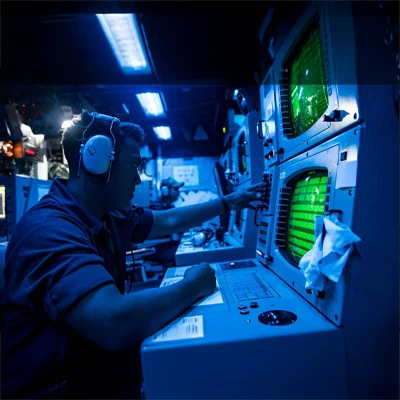
Old fashioned sonar studies needed a highly trained operator to differentiate between biological noise, commercial ship experiences, and enemy submarines. A large portion of this classification is now automated with the assistance of AI. This decreases the workload on operators and the level of human error especially during the high-pressure situation.
Predictive analytics also complements Underwater Threat Detection since it predicts the probable routes of the submarine, depending on a model of the environmental conditions, and the past behavioral patterns.
In the case of defense technology companies, AI-powered sonar platforms present fresh service models, such as data analytics subscriptions, acoustic signature databases in the cloud and long-term performance optimization contracts.
Active, Passive, and Hybrid Sonar Architectures
The current sonar technology as used in the naval defense has a mix of both active and passive detection techniques. Passive sonar is stealthy and listens to acoustic noise emitted by the target and is therefore not as effective as active sonar.
Active sonar sends acoustic pulses and waits to hear echoes giving specific range and bearing information. Although a good solution, it may expose the location of the transmitting platform.
The use of next-generation sonar technologies to perform naval surveillance uses hybrid methods. Adaptive systems change between passive and active mode dynamically based on the conditions of threats and the goals of operation.
Low frequency active sonar is most useful in deep ocean anti-submarine warfare and high frequency systems are used in mine detection and protection of harbors. The capability of combining many sonar modalities into a single Advanced naval sonar system improves flexibility in the mission.
The Role of Unmanned Platforms and Distributed Sonar Networks
The growth of unmanned surface and under water ships is transforming the maritime security operations. Small Underwater acoustic detection systems can be installed on unmanned platforms, which have the ability to work in high risk areas without subjecting the crewed vessels to risk.
Distributed sonar networks produce overlapping acoustic surf coverage in extensive regions of the sea. Multi-static corpus where one platform is emitting and the other receiving improves the chances of detection against stealth submarines.
To shipbuilders and defense suppliers, uniform sonar payloads, which integrate with unmanned systems, are a very fast-emerging market niche. Navies are becoming highly in need of scalable sonar systems that can be adapted to frigates, destroyers, submarines, helicopters, and even to unmanned systems.
Industrial and Procurement Implications
Modernization of the Naval Surveillance System entails intricate procurement cycles, long term maintenance contracts and cooperation strategy between the naval and the defense contractors.
The most important factors to procurement decision-makers are lifecycle cost, modularity, upgrade paths, interoperability and training requirements.
The contemporary sonar solutions to the maritime security operation are commonly supplied as integrated combat systems. It leads to the cooperation of sonar manufacturers, shipyards, integrators of combat systems, and software developers.
The players in the industry that invest in the research and development of Next-Generation Naval Sonar Technologies get the access to the multi-year defense contracts and export opportunity internationally. But, adherence to export policies, cybersecurity policies, and state technology specifications is of paramount importance.
Environmental and Regulatory Considerations
With the increasing power of Advanced sonar systems of submarine threat detection, there is more scrutiny of the environmental aspects. Active sonar transmissions have the ability to impact marine life and therefore there are regulatory guidelines which are enforced in some of the areas of operation.
Defense contractors and navies have to reconcile the need to be operational with the need to adhere to the environment. Environmental impact is mitigated by the aid of adaptive control of transmission power, environmental impact modeling, and advanced signal shaping techniques.
In a B2B approach, compliance capability with the environment can distinguish vendors during the competition tenders.
Cybersecurity and Data Integrity in Sonar Networks
Cybersecurity threats have increased with digitization of the Naval Surveillance Systems. The cyber intrusion, manipulation of data or interference with electronic warfare could target networked sonar platforms.
Elaborate sonar systems in the navy have also been integrated with encrypted communications code, safe data connections, and robust architectures to avoid disruptions.
The need by defense organizations to be zero-trust and hardened firmware is growing to make sure that sonar systems to defend against naval threats can continue to operate in challenged cyber conditions.
Training, Simulation, and Human Capital Development
Although automation has been developed, a professional staff is still necessary in Underwater Threat Detection. Training platforms are now simulated and mimic the actual acoustic environment, providing the operator an opportunity to train on classification and engagement strategies.
Virtual and augmented reality devices help in making operators prepared and lessened the expensive at-sea drills.
To the suppliers of this industry, the combination of training packages with sonar equipment generates new sources of income and builds a strong connection with clients in the long-term perspective.
Future Outlook: Toward Cognitive and Quantum-Enhanced Sonar
The second wave of next generation sonar technologies in naval surveillance involves cognitive sonar systems that are able to dynamically modify the pattern of transmission in realtime in response to the environmental feedback.
The quantum sensing technologies are also under research, and this could be used to improve sensitivity of detection, which could be a breakthrough in Underwater acoustic detection systems.
Also, new developments in materials science and transducer design have the potential to produce lighter, energy efficient sonar arrays that can be used on smaller unmanned platforms.
Due to the increasing competition in the sea, the evidence-based sonar systems used in detecting threats posed by a sub-marine will continue to increase.
Executive Summary for Industry Leaders
Next-Generation Naval sonar technologies are changing the way maritime defense is conducted by incorporating AI, distributed sensor networks, and digital signal processing in the development of advanced naval sonar systems.
The Naval Surveillance Systems are becoming integrated ecosystems enhancing Underwater Threat Detection both in deep ocean and littoral settings.
The underwater acoustic detection systems are currently based on multi-static configurations, hybrid active-passive systems and real-time sharing of data.
Naval defense sonar systems have become increasingly cyber-resilient, software-defined, and modular enough to support the scalable modernization of fleets.
Maritime security operations using modern naval sonar systems are efficient segment of the world defense markets that are experiencing higher growth rates in terms of geopolitical tension, and modernization programs of undersea warfare.
Conclusion: Securing the Future Beneath the Waves
The undersea space has been turned into one of the most strategically important arenas of current defense. With the increased silence of the submarine and the increase of the dangers of the submarine, the dependency on the Advanced naval sonar systems increases.
Naval surveillance in the next generation sonar systems gives the navies instruments to identify, categorize and react to the threat in the real time. These systems transform the maritime surveillance technologies by incorporating the elements of artificial intelligence, network-centric operations, unmanned systems, and secure digital architectures.
The future direction to take among the stakeholders in the defense industry is sustainable innovation, strategic alliances, and lifecycle-driven solutions. With countries building their maritime superiority, Next-Generation Naval Sonar Technologies will continue to play the pivotal role of protecting the sea routes around the world, defending the national interests, and establishing operational superiorities below the sea.
 Our Services
 Media Pack Download
 Newsletters
 Industrial Events