

Types of Sonar Systems Used by Navies around the World
Navies everywhere use sonar systems to look for enemy submarines, move past hazards in the ocean and stay away from underwater bombs. Did you realize that countries around the world use sonar in several ways using different technologies? When you understand sonar technology, you can learn more about the ways acoustic warfare, detection underwater and stealth tactics are used in naval activities today.
Navies rely on a wide range of sonar equipment to maintain dominance beneath the waves, from basic echo detectors to sophisticated imaging systems.
Here, we’ll examine the different sonar systems operating in navies, the role they play and how progress in sonar defense for the military is helping to mold the future of sonar systems.
What is SONAR and Why Do Navies Rely on It?
The name SONAR stands for Sound Navigation and Ranging. It relies on sound to detect various objects where it is operating, travel in the water and send messages. Like fish, naval forces depend on sonar to detect hidden submarines, position mines, lead torpedoes toward targets and perform wave surveillance.
Due to the growing threats on seas and oceans, detection by naval sonar is now a key aspect of protecting the country. Now, sonar is a key part of naval security for both experts and the wider maritime community.

This widespread reliance reflects the growing importance of sonar systems in naval defense applications, offering both strategic and tactical advantages.
Classification of Sonar Systems
With various types of sonar systems used by navies worldwide, each plays a unique role in securing maritime domains. Before diving into each type, let’s understand how naval sonar systems are categorized:
| Sonar Type | Description | Common Naval Use |
| Active Sonar | Emits pulses and listens for echoes | Target detection, submarine tracking |
| Passive Sonar | Listens to external sounds | Stealth surveillance, enemy detection |
| Towed Array Sonar | Long arrays towed behind vessels | Long-range submarine detection |
| Hull-mounted Sonar | Fixed to ship's hull | General underwater detection |
| Variable Depth Sonar (VDS) | Lowered to various depths | Submarine tracking in thermal layers |
| Dipping Sonar | Deployed from helicopters | Quick and mobile scanning |
| Side-scan Sonar | Scans sea floor with sound beams | Mine detection, seabed mapping |
| Synthetic Aperture Sonar | High-resolution imaging | Mine hunting, undersea surveillance |
Active Sonar Systems: The Sound of Detection
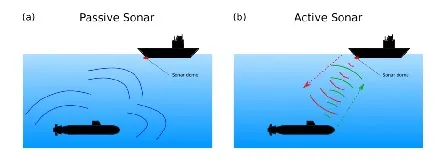
To locate objects, sonar systems are widely employed by navies by sending sound pulses that hit things and send back echoes. Pingers are often used in submarine films when we can hear the sound and this allows the system to spot the distance, size and speed of underwater targets.
While powerful, they can expose the emitting vessel’s location, making them a double-edged sword in stealth operations. Still, active sonar remains a fundamental tool in modern naval sonar systems.
Passive Sonar: Silent but Deadly
Passive sonar systems do not emit any sound. Instead, they listen for acoustic signals from enemy submarines, engines, or propellers. This makes them ideal for covert surveillance and underwater detection without alerting adversaries.
These passive sonar systems in modern navies are used extensively in submarines and warships, often integrated with buoys and underwater barriers. The combination of passive and active sonar systems in modern navies ensures both stealth and precision in hostile environments.
Towed Array Sonar Systems: Listening from a far
One of the most advanced types of sonar sensors used in naval vessels, towed array sonar systems involve long hydrophone arrays dragged behind a ship. Protecting the sonar sensors from interference with the ship’s noise allows better listening.
Such systems play a major role in ASW by spotting submarines from far away. A lot of navies’ sonar suppliers choose towed array systems because of their strong performance. These systems are often developed and maintained by leading sonar system suppliers for navies, ensuring high-performance capabilities at sea.
Hull-Mounted Sonar Systems: The Frontline Sensor
The sonar systems are attached directly to the hull or bow, acting as the vessel’s safety net in its first line of defense. They may be put to use actively or passively and can spot hazards, keep an eye underwater and alert the ship to torpedo attacks.
Although depth is restricted on these sonars, they are used on most warships because they can work with several configurations.
Variable Depth Sonar (VDS): Beyond the Thermal Layer
Ocean water temperature layers can disrupt sound travel. Variable Depth Sonar (VDS) tackles this by adjusting the sonar’s depth to “see” through layers where submarines often hide.
These systems are a staple in naval sonar technology on destroyers and frigates designed for submarine hunting, especially in regions with strong thermal gradients.
Dipping Sonar: Eye in the Sky, Ear in the Water
Used by ASW helicopters, dipping sonar is lowered into the water to perform quick scans of suspect areas. Typically guided by long-range ship sensors, the helicopter pinpoints threats with real-time sonar drops.
Fast, reactive, and highly effective, dipping sonar is a game-changer in protecting surface fleets.
Side-Scan Sonar: Painting the Sea Floor
Though it does not look for submarines, side-scan sonar is strong at seeing the bottom of the sea, spotting mines, wrecked ships and hazards below water. The device creates a picture of the oceans’ bottom by emitting pulses laterally.
Naval forces use side-scan sonar in mine-hunting vessels and underwater drones, helping ensure safe navigation.
Synthetic Aperture Sonar (SAS): Precision Imaging for Modern Navies
Synthetic Aperture Sonar is the leading edge in the sonar industry. Because they provide very clear images of the seabed, SAS systems are vital for spotting mines, inspecting underwater facilities and gathering intelligence at sea.
Usually, SAS is placed on autonomous underwater vehicles (AUVs) or remotely operated robotics (ROVs) and is now widely applied in different naval settings.
New Sonar Technologies for Submarines in 2025
Recent advances in sonar technology for naval defense have focused on increasing accuracy, autonomy, and survivability in contested waters. In the next few years, submarine sonar is guided by a drive for automation, accuracy and greater integration:
- Artificial Intelligence (AI): Helps find the target by telling apart noises caused by animals from those made by enemies.
- Underwater Drones with Sonar: AUVs and UUVs that have sonar can perform underwater exploration without placing crew at risk.
- Networked Sonar Systems: Sharing data in real time by ships, drones and submarines increases the overall sense of awareness.
- Multi-static Sonar Systems: Dispersion of both emitters and receivers in Multi-static Sonar leads to better detection and less vulnerability to countermeasures.
Such breakthroughs point to how the military will use sonar systems, with smarter, safer and more linked options leading the way in underwater defense.
Conclusion: The Silent Game-Changer
In the modern navy, sonar is essential to both active methods and to creating clear images with SAS which are responsible for key roles in current maritime operations. Every sonar system is necessary for protecting the sea, supporting undetectable naval actions and helping with awareness about the situation.
Because AI, automation and real-time networking are advancing naval sonar, future sonar systems will grow in importance for naval defense.
A sonar system is not only used to detect submarines; it’s also about knowledge of sound, strategies and quiet underwater threats. As navies evolve, the future of sonar systems in the military promises smarter integration, deeper detection, and enhanced situational dominance.
These developments highlight the growing significance of naval sonar technology for underwater detection in today’s maritime defense strategy.
 Our Services
 Media Pack Download
 Newsletters
 Industrial Events