

Latest Advances in Electronic Warfare Systems for Multi-Domain Operations
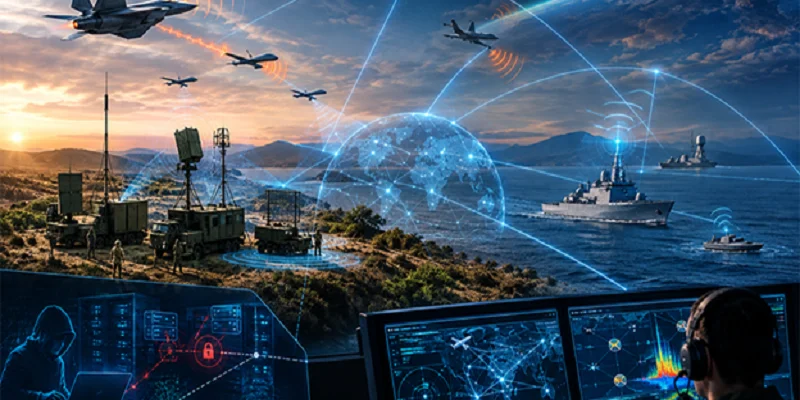
Quick answer: Modern electronic warfare (EW) has moved from single-platform jamming to networked, AI-assisted systems that sense, decide, and act across land, air, sea, space, and cyber simultaneously. The biggest shifts in 2026 are software-defined architectures, AI-enabled signal processing, and EW systems built to plug directly into multi-domain command networks rather than operate as standalone boxes.
If you've researched this space before, you already know the old picture: EW meant a jammer on a jet, a radar-warning receiver, maybe a ground-based system for counter-IED work. That picture is outdated. Today's battlespace is congested, contested, and shared across five domains at once - and electronic warfare technology has had to evolve just as fast as the threats it's meant to counter.
This article breaks down what's actually changed, why it matters, and where multi-domain EW systems are headed next.
Why Multi-Domain Electronic Warfare Is the New Standard
Multi-domain operations (MDO) are built on a simple premise: modern adversaries don't fight in one domain, so friendly forces can't defend in one domain either. A drone swarm might be coordinated over a cellular network, guided by satellite positioning, and controlled from a command post hundreds of kilometers away. Defeating that requires spectrum awareness across air, space, and cyber - all at once.
This is exactly why armies are restructuring around it. The U.S. Army recently activated its Multi-Domain Command-Pacific, combining the 7th Infantry Division and the 1st Multi-Domain Task Force into a single mobile force designed to deliver cyber, space, electronic warfare, intelligence and fires effects in theater. That's not a minor reorg - it's a signal that electronic warfare capabilities are now treated as a core maneuver function, not a support afterthought.
NATO and allied forces are following the same logic. Planning documents describe multi-domain units operating across land, maritime, air, space, cyberspace and electronic warfare domains in carrying out counter anti-access and area denial (A2/AD) operations, with dedicated battalions tasked to disrupt enemy operations through electronic jamming, cyberattack, and psychological operations working in concert.
What's Actually New in Electronic Warfare Technology
1. Software-Defined, AI-Assisted Systems
The single biggest technical shift is the move away from fixed-function hardware toward software-defined EW. Instead of building a jammer that handles one threat signature, modern systems use wideband receivers and reprogrammable architecture that can be updated as threats change - sometimes in near real time.
Industry analysts point to exactly this trend as the market's growth engine, noting expansion driven by advances in software-defined systems, artificial intelligence, signal processing, adaptive jamming technologies, and cyber-electromagnetic integration, all aimed at improving spectrum control and situational awareness. Upcoming industry discussions are framing this as the field's defining transformation, with electronic warfare described as undergoing a fundamental transformation as adversaries adopt more agile, adaptive, and spectrum-aware systems, pushing the response toward AI-enabled signal processing and open systems architecture.
In practice, this means an EW operator isn't limited to what a system shipped with. Updates can be pushed the way software updates ship to a phone - closing the gap between "a new threat appears" and "we can counter it."
2. Layered, Networked Architectures Instead of Standalone Boxes
The days of a single jammer defending a single asset are fading. Defense contractors are now designing EW as one layer in an integrated architecture where sensors, effectors, and decision-making tools share data automatically.
A good illustration: at SAHA 2026, ASELSAN unveiled updated versions of its KORAL air-defense EW system and ILGAR communications EW system as part of a broader portfolio the company describes as a layered and integrated defense architecture, bringing together electronic warfare, counter-UAV, airborne and naval capabilities within a unified operational framework. The company frames this explicitly as a networked operational framework where sensors, effectors, and decision-making elements operate in coordination - rather than isolated tools.
The upgraded KORAL variant is built to provide advanced electronic support and attack capabilities against hostile radar systems, enabling detection, classification, and suppression at long ranges, while the companion communications system adds mobile electronic attack capabilities targeting V/UHF and partial SHF communication systems. That pairing - radar-focused attack plus communications-focused attack - is template other defense EW systems are converging on.
3. Command-and-Control Integration
Advanced electronic warfare systems are increasingly judged not just by jamming power but by how well they feed into joint command-and-control networks. The U.S. Army's Next Generation Command and Control initiative, backed by roughly $555.2 million in FY2026 budget allocations, is built around exactly this kind of integration - connecting EW, fires, and situational-awareness data so decisions happen faster across a distributed force.
This matters because spectrum operations are only as useful as the decisions they inform. An EW system that detects a threat but can't relay that data to a commander in seconds is operating at a real disadvantage against systems that can.
4. Counter-Drone and Counter-Swarm Capabilities
Much of the recent investment in electromagnetic spectrum operations is being driven by one problem: cheap, numerous drones. Market researchers note that land-based EW platforms - vehicle-mounted units, fixed installations, mobile shelters, counter-unmanned aerial system technologies, counter-improvised explosive device EW solutions, and dismounted soldier systems - are expected to lead platform demand, largely because of how effective spectrum disruption is against drone command links and GPS-guided munitions.
5. Growing Investment Behind the Technology
None of this is happening in a vacuum. The global electronic warfare market is estimated to reach USD 32.35 billion in 2026 and is projected to grow to USD 64.66 billion by 2031, registering a compound annual growth rate of 14.9%. Europe in particular is expected to see the fastest growth, driven by rising defense expenditure, continuing military modernization programs, and increased investment in regional defense capabilities, as countries prioritize spectrum dominance alongside broader multi-domain readiness.
How Adversary Doctrine Is Shaping the Response
It's worth noting this isn't a one-sided technology race. Peer competitors are investing heavily in their own electronic warfare doctrine. Recent defense-industry coverage examines how one major power is preparing to fight in the electromagnetic spectrum, with an evolving approach that blends information superiority and cyber integration to systems destruction and multi-domain operations. That's part of why Western and allied procurement has accelerated: multi-domain EW systems aren't being built in isolation - they're being built as a direct response to how contested the spectrum has already become.
Where This Is Headed
A few patterns are clear heading into the next procurement cycle:
- Open architecture will keep winning. Systems that can be updated without a full hardware swap will outlast fixed-function designs.
- EW will keep merging with cyber and space. The line between "jamming a signal" and "disrupting a network" is getting thinner every year.
- Speed of decision-making becomes the real differentiator. As more systems detect threats, the advantage shifts to whichever force can turn detection into action fastest.
- Expect more unified showcases, following the pattern set at events like Eurosatory 2026, where electronic warfare platforms are displayed alongside precision strike, air defense, and autonomous systems as parts of one interoperable ecosystem rather than separate product categories.
Frequently Asked Questions
What is multi-domain electronic warfare?
It's the use of EW capabilities - jamming, signal detection, spectrum control - coordinated across land, air, sea, space, and cyber domains simultaneously, rather than confined to a single platform or environment.
Why are electromagnetic spectrum operations important in modern defense?
Because nearly every modern weapon system, from drones to precision munitions, depends on the spectrum for communication or guidance. Controlling it means controlling how effectively an adversary's systems function.
What makes an EW system "advanced" today?
Software-defined, reprogrammable hardware; AI-assisted signal processing; and the ability to network with command-and-control systems rather than operate as a standalone unit.
Are counter-drone systems part of electronic warfare?
Yes - counter-UAS and counter-swarm technology is one of the fastest-growing segments within defense EW systems, largely because drones are cheap, numerous, and heavily reliant on the spectrum.
 Our Services
 Media Pack Download
 Newsletters
 Industrial Events