

Electronic Warfare & Countermeasures: What Defence Procurement Teams Need Now
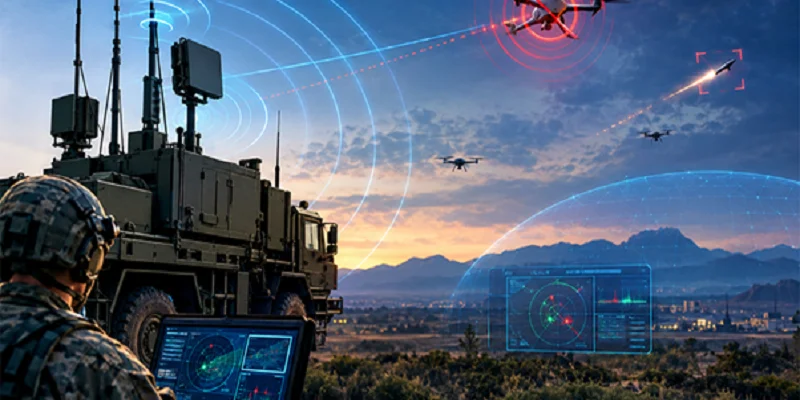
The battlefield has gone quiet in a way that should worry anyone responsible for military acquisitions. Not quiet because the fighting has stopped, but quiet because the fight has moved into a domain most people can't see, hear, or touch: the electromagnetic spectrum. Drones are jammed out of the sky mid-flight. Guided munitions lose their lock seconds before impact. Entire communications networks go dark without a single shot fired. This is electronic warfare, and it has quietly become one of the most decisive factors in modern conflict.
For defence procurement teams, this shift changes everything about how systems get evaluated, budgeted, and bought. Electronic warfare procurement is no longer a niche line item buried inside a broader modernization program — it's becoming the program. Teams that treat it as an afterthought are going to find themselves outpaced, and teams that get ahead of it are going to shape how the next decade of defence acquisition actually works.
Why Electronic Warfare Procurement Is Suddenly Urgent
Three things happened almost simultaneously to push electronic warfare systems to the top of every serious procurement agenda.
First, drone warfare matured faster than anyone expected. Cheap, mass-produced unmanned systems proved they could inflict expensive damage, and the only reliable counter at scale turned out to be electronic - not kinetic. You can't shoot down thousands of drones with missiles that cost more than the drones themselves. You jam them, spoof their GPS, or sever their control links instead.
Second, near-peer adversaries invested heavily in their own defence EW systems, from long-range jammers to sophisticated signal intelligence platforms. That investment forced Western militaries to treat electronic warfare countermeasures as a survivability requirement, not an optional upgrade.
Third, the cost asymmetry became impossible to ignore. A jamming pod or a directed countermeasure system is often a fraction of the cost of the missile, drone, or guided weapon it neutralizes. For budget-conscious procurement teams facing tighter defence spending scrutiny, that math is compelling on its own.
Put together, these forces mean electronic warfare systems for defence procurement have moved from a specialist concern to a mainstream acquisition priority, and the teams managing these programs need a much sharper understanding of what they're actually buying.
What Counts as an Electronic Warfare System Today
It helps to be precise about scope, because "electronic warfare" covers a wide and fast-moving category. Broadly, military electronic warfare systems fall into three functional buckets.
Electronic attack covers offensive capabilities - electronic jamming of enemy radar, communications, and navigation signals, plus directed energy and spoofing tools designed to degrade or deceive an adversary's electronic systems.
Electronic protection covers the defensive side - hardening friendly systems against jamming, spoofing, and interception, including frequency-hopping radios, anti-jam GPS receivers, and resilient waveform designs.
Electronic support covers detection and intelligence - sensors and receivers that identify, locate, and classify enemy emissions so commanders know what's out there before deciding how to respond.
Modern defence jamming systems increasingly blend all three functions into integrated platforms rather than standalone boxes. A vehicle-mounted counter-drone system today might detect a threat, classify its signal signature, and jam it automatically within seconds - all without a human pulling a trigger. That level of integration is exactly why procurement evaluation has gotten more complicated, and why generic acquisition frameworks built for legacy hardware don't map cleanly onto this category anymore.
The Procurement Challenge: Buying Something That Changes Monthly
Traditional defence procurement assumes a relatively stable requirement: define the specification, run the competition, select a winner, field the system for a decade or more. Electronic warfare breaks that model.
The electromagnetic environment shifts constantly. Adversaries update waveforms, frequencies, and jamming techniques on operational timescales, sometimes within a single conflict. A system judged best-in-class during source selection can be measurably less effective eighteen months later if it can't be updated. This is the central tension procurement officers now have to manage: buying a capability that needs to behave more like software than hardware, inside acquisition processes still largely built around hardware.
That tension shows up in a few recurring pain points:
- Requirements drift. By the time a lengthy competitive process concludes, the threat picture used to write the original requirement may already be outdated.
- Testing complexity. Validating jamming and countermeasure performance requires controlled electromagnetic ranges and classified threat data that aren't always readily available to evaluation teams.
- Interoperability risk. A system that performs brilliantly in isolation can create friendly-fire problems for its own side's communications and sensors if it isn't properly integrated.
- Vendor lock-in versus open architecture. Proprietary systems are often faster to field but harder to upgrade; open-architecture systems are more adaptable but demand more integration effort upfront.
Recognizing these patterns early is what separates procurement teams that deliver capability on time from those that get stuck in endless requirement rewrites.
EW System Selection Criteria for Defence Buyers
Given that complexity, what should actually guide a purchasing decision? A useful set of EW system selection criteria for defence buyers tends to cluster around five areas.
1. Adaptability and software-defined architecture. Systems built on software-defined radio and open architecture principles can be reprogrammed against new threats without a hardware swap. This single factor increasingly determines whether a system remains relevant for its full service life or becomes obsolete within a few years.
2. Interoperability with existing platforms. A new jamming or countermeasure system has to coexist with existing radios, radar, and sensor suites without degrading them. Buyers should demand demonstrated compatibility testing, not vendor assurances.
3. Scalability across platforms and mission sets. The best EW procurement solutions today are modular enough to scale from a dismounted soldier's kit to a vehicle, vessel, or aircraft, reducing the number of separate programs a procurement office has to manage.
4. Supportability and sovereign capability. Spectrum threats evolve too fast to rely entirely on foreign vendors for updates. Teams should weigh how much of the software, waveform library, and update pipeline they can control domestically, especially for systems tied to national security.
5. Total lifecycle cost, not just unit price. Electronic warfare systems live or die on their update cycle. A cheaper system with expensive, infrequent software refreshes can cost more over ten years than a pricier system with a built-in upgrade path.
Weighting these five factors consistently across a competition - rather than defaulting to lowest price or fastest delivery - is what separates a resilient acquisition from one that needs replacing in three years.
Building an Electronic Warfare Procurement Strategy That Holds Up
A few practical shifts help procurement teams keep pace with this category.
Treat electronic warfare countermeasures as a continuously updated capability rather than a fixed deliverable. Build contracts with scheduled software and waveform refresh cycles rather than a single delivery milestone, and budget for those refreshes as a recurring line rather than a one-time cost.
Shorten evaluation cycles where possible. Rapid prototyping pathways and iterative field trials give a far more realistic picture of performance against evolving threats than a single static test event conducted months before fielding.
Involve end users early. Operators who will actually carry or deploy defence EW systems often spot integration and usability problems that lab testing misses entirely, and their feedback loop should be built into the acquisition timeline, not bolted on afterward.
Build spectrum management into the requirement from day one. A jamming system that interferes with a nation's own communications network is a liability, not an asset, so coordination with spectrum authorities needs to happen during design, not after fielding.
Finally, diversify the vendor base where the mission allows it. Relying on a single supplier for critical electronic jamming or protection capability creates a single point of failure, both operationally and in the supply chain.
Frequently Asked Questions
What is electronic warfare procurement?
Electronic warfare procurement is the process of acquiring military systems that use the electromagnetic spectrum to attack, protect, or gather intelligence on enemy electronics — including jammers, anti-jam receivers, and signal detection platforms.
Why are defence EW systems a growing procurement priority?
Drone proliferation, near-peer investment in jamming and spoofing capability, and the cost advantage of electronic countermeasures over kinetic weapons have all pushed electronic warfare systems toward the top of modern defence budgets.
What is the difference between electronic attack and electronic protection?
Electronic attack disrupts or deceives enemy systems, such as jamming enemy radar. Electronic protection defends friendly systems against the same tactics, such as anti-jam GPS or frequency-hopping radios.
What should buyers prioritize when selecting an EW system?
Adaptability through software-defined architecture, interoperability with existing platforms, scalability across mission sets, sovereign supportability, and total lifecycle cost are the core selection criteria for defence buyers.
The Bottom Line
Electronic warfare has stopped being a specialist add-on and become a core pillar of modern defence capability. For procurement teams, that means rethinking timelines, contracts, and evaluation criteria built for a different kind of hardware. The organizations that adapt their acquisition models now - favoring adaptable, interoperable, and continuously updatable systems - will be the ones fielding credible electronic warfare countermeasures when it actually matters. The ones that don't will be running competitions for capability that's already obsolete by the time it reaches the field.
 Our Services
 Media Pack Download
 Newsletters
 Industrial Events