

Best Autonomous and Swarm Drone Technologies for Defense Operations
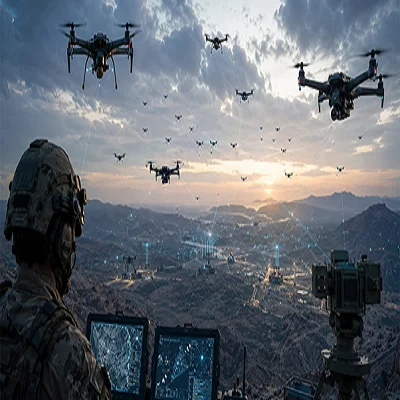
Modern warfare is being redefined at machine speed. As threats become faster, more distributed, and more data-driven, defense forces around the world are turning to autonomous drones and swarm drones to gain a decisive edge. From border surveillance to contested-airspace combat missions, military UAVs are no longer optional support assets — they are becoming central to how militaries plan, sense, and strike.
This article breaks down the most important autonomous drone systems for defense, explains how military swarm drone technologies work, and answers the questions defense procurement teams, systems integrators, and technology leaders are asking most often about this fast-moving space.
What Are Autonomous Drones in Defense?
Autonomous drones are unmanned aerial vehicles (UAVs) capable of performing missions with minimal or no human intervention. Unlike remotely piloted drones that require a dedicated operator for every maneuver, autonomous systems use onboard sensors, edge computing, and artificial intelligence to make real-time decisions — navigating terrain, avoiding obstacles, identifying targets, and adjusting flight paths independently.
In defense operations, autonomy isn't just a convenience. It's a force multiplier. A single operator can now oversee dozens of aircraft simultaneously, communication delays no longer stall mission-critical decisions, and platforms can continue operating even when GPS or data links are jammed or denied.
Key capabilities that define modern autonomous drone systems for defense include:
- Autonomous navigation using inertial, visual, and terrain-based positioning
- Real-time target recognition powered by onboard machine learning models
- Self-healing mission planning that adapts routes when conditions change
- Denied-GPS operation for contested electronic warfare environments
- Sensor fusion combining radar, EO/IR, LiDAR, and signals intelligence
The Rise of Drone Swarm Technology
If autonomous drones represent intelligence at the individual platform level, drone swarm technology represents intelligence at the collective level. Swarm systems deploy dozens, hundreds, or even thousands of coordinated drones that communicate with each other in real time, distributing tasks, sharing sensor data, and adapting formation and behavior without a central point of failure.
This shift from single-platform autonomy to networked, collaborative autonomy is arguably the single biggest change in unmanned defense technology over the past several years.
Why Swarms Matter Strategically
- Resilience through redundancy — losing individual units doesn't compromise the mission
- Saturation capability — swarms can overwhelm enemy air defense systems that are designed to track a limited number of individual threats
- Distributed sensing — a swarm can cover far more terrain and gather richer intelligence than a single high-value platform
- Cost asymmetry — a swarm of low-cost drones can neutralize or distract far more expensive defense assets, shifting the economics of modern conflict
Military planners increasingly view swarm drones not as a future concept but as an operational reality already being tested and fielded across multiple theaters.
How Military Swarm Drone Technologies Work
At the core of any swarm system is a mesh communication network that allows drones to exchange positional, sensor, and mission data continuously. Each unit typically runs a lightweight AI model capable of local decision-making, while a broader swarm-level algorithm governs collective behavior — similar in principle to how flocks of birds or schools of fish coordinate movement without centralized control.
The most advanced military swarm drone technologies rely on a layered architecture:
- Edge AI on each drone — enabling object detection, obstacle avoidance, and threat classification without needing constant connectivity to a command center
- Swarm intelligence algorithms — coordinating formation, task allocation, and target prioritization across the group
- Resilient mesh networking — ensuring the swarm continues functioning even if individual nodes are lost or communications are partially disrupted
- Human-machine teaming interfaces — giving commanders high-level control (mission objectives, rules of engagement) while the swarm manages execution autonomously
This architecture allows swarms to perform complex tasks such as coordinated reconnaissance sweeps, simultaneous multi-angle strikes, or perimeter defense — all with a fraction of the manpower traditional operations would require.
AI-Powered Defense UAVs: Intelligence at the Edge
AI-powered defense UAVs are what make both individual autonomy and swarm coordination possible. Onboard artificial intelligence handles tasks that used to require a human analyst reviewing footage after the fact — now performed instantly, mid-flight.
Core AI functions in modern defense UAVs include:
- Computer vision-based object and vehicle classification
- Anomaly detection for identifying unusual troop or vehicle movement
- Predictive threat modeling based on pattern-of-life analysis
- Autonomous target tracking that maintains lock even through occlusion or evasive maneuvers
- Natural language mission tasking, allowing operators to issue high-level commands rather than manual flight instructions
The shift toward AI-enabled onboard processing also reduces the burden on satellite and radio bandwidth, since drones can transmit only relevant, pre-processed intelligence rather than raw video feeds — a critical advantage in contested or bandwidth-limited environments.
Autonomous Combat UAV Systems: Key Features to Evaluate
For defense organizations evaluating autonomous combat UAV systems, several factors separate mission-ready platforms from early-stage prototypes:
1. Autonomy Level Systems range from partially autonomous (human-in-the-loop for weapons release) to fully autonomous (human-on-the-loop, supervisory control only). Most current defense deployments maintain human authorization for lethal action, in line with international norms and rules of engagement.
2. Survivability and Stealth Low radar cross-section design, reduced acoustic signature, and electronic warfare resistance determine how well a platform survives in contested airspace.
3. Payload Flexibility Modular payload bays that support ISR sensors, electronic warfare packages, or precision munitions give a single airframe multi-mission capability.
4. Endurance and Range Loitering time and operational radius directly affect how much territory a single mission can cover before refueling or battery replacement.
5. Interoperability The ability to integrate with existing command-and-control (C2) systems, NATO data-link standards, and joint force networks is often the deciding factor in procurement.
AI-Enabled Swarm Drones for Modern Military Missions
The practical mission sets for AI-enabled swarm drones in modern military contexts continue to expand:
- Intelligence, Surveillance, and Reconnaissance (ISR): Swarms cover large geographic areas simultaneously, feeding a unified real-time picture back to command centers.
- Electronic Warfare and Jamming: Distributed swarms can degrade enemy radar and communications across a wide front.
- Decoy and Deception Operations: Low-cost swarm units can mimic larger formations, drawing enemy fire and depleting costly interceptor missiles.
- Border and Perimeter Security: Persistent swarm patrols detect and track intrusions without fatigue-related coverage gaps.
- Search and Rescue in Combat Zones: Swarms scan wide areas rapidly to locate personnel, reducing risk to human search teams.
- Coordinated Strike Operations: Multiple drones approach from different vectors simultaneously, complicating enemy defense response timing.
Advanced Autonomous UAV Systems for Intelligence and Combat Operations
Leading defense technology providers are converging on a common vision: advanced autonomous UAV systems for intelligence and combat operations that combine long-endurance ISR platforms with expendable, swarm-capable strike drones — creating a layered, tiered force structure.
This tiered approach typically includes:
- High-end, long-endurance autonomous UAVs for persistent ISR and command-level situational awareness
- Mid-tier tactical drones for squad- and platoon-level reconnaissance
- Low-cost, attritable swarm units deployed in mass for saturation, decoy, or strike missions
This layered structure allows militaries to balance cost, risk, and capability — reserving expensive, high-value assets for strategic missions while accepting greater risk tolerance with expendable swarm units.
Benefits for Defense Organizations
Organizations adopting autonomous and swarm drone technologies report measurable operational advantages:
- Reduced risk to personnel in high-threat environments
- Faster decision cycles through real-time AI-processed intelligence
- Lower lifecycle costs compared to traditional manned platforms
- Scalable force projection without proportional increases in manpower
- Improved mission persistence through distributed, redundant systems
Challenges and Considerations
Despite rapid progress, defense leaders must navigate real challenges:
- Regulatory and ethical frameworks governing autonomous weapons use
- Cybersecurity risks associated with networked swarm communications
- Counter-UAS and counter-swarm defenses being developed by adversaries
- Integration complexity with legacy command-and-control infrastructure
- Training and doctrine development for human-machine teaming at scale
Procurement teams evaluating vendors should prioritize systems with proven interoperability, transparent AI decision logic, and strong cybersecurity architecture.
Frequently Asked Questions
What is the difference between autonomous drones and swarm drones?
Autonomous drones operate independently using onboard AI for navigation and decision-making, while swarm drones are groups of autonomous units that communicate and coordinate behavior collectively to complete shared mission objectives.
Are military UAVs fully autonomous today?
Most operational military UAVs use a mix of autonomous functions — navigation, target identification, obstacle avoidance — while keeping a human in or on the loop for weapons-release decisions, in accordance with current rules of engagement.
How do AI-powered defense UAVs improve mission outcomes?
They process sensor data onboard in real time, enabling faster threat detection, reduced bandwidth dependency, and quicker decision-making compared to systems that rely on manual, ground-based analysis.
Why are militaries investing in drone swarm technology?
Swarms offer resilience, cost-efficient mass, and the ability to overwhelm traditional air defense systems, making them a strategically valuable complement to high-value manned and unmanned platforms.
What industries build autonomous combat UAV systems?
Defense primes, specialized UAV manufacturers, and defense-focused AI and robotics companies are the primary developers, often working alongside government research agencies and armed forces on testing and integration.
Final Thoughts
The convergence of autonomy, artificial intelligence, and swarm coordination is reshaping defense operations at every level — from battlefield reconnaissance to strategic deterrence. As autonomous drone systems for defense mature, and as military swarm drone technologies move from experimental trials to operational deployment, defense organizations that invest early in interoperable, AI-enabled platforms will be best positioned to maintain a decisive advantage in future conflicts.
For defense technology providers, systems integrators, and procurement leaders, the message is clear: autonomous and swarm drone capability is no longer an emerging trend — it is becoming a baseline requirement for modern military readiness.
 Our Services
 Media Pack Download
 Newsletters
 Industrial Events