

Best Advanced Sensor and Optronics Systems Powering Precision Warfare
Introduction: Precision Warfare as a Sensor-Driven Battlefield
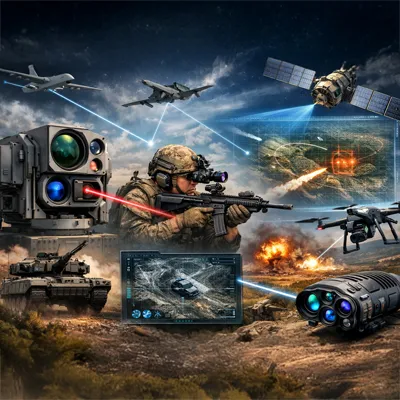
The contemporary warfare has taken a negative turn in favor of the intelligence-based and precision warfare instead of the brute force conflict. The most important element of this revolution is more sophisticated sensor and optronics systems which allow the military to see deeper, recognize quicker, and make wiser decisions and attack with precision never seen before. The warfare of today is not characterized by the magnitude of an arsenal, but by the caliber of information collected, computed and implemented in real time. This information superiority has been enabled by the latest military sensor techniques and defense optronics technology, which provides collective surveillance, reconnaissance, targeting, and strike operations in land, air, sea, space, and cyber space.
Next-generation defense sensor and optronics systems investments are no longer an option in the case of defense manufacturers, system integrators, and armed forces. They play a vital role in terms of sustaining strategic edge in more competitive and electronically tricky settings.
Understanding Advanced Sensor and Optronics Systems in Defense
The advanced sensor and optronics systems are the integrated technologies which combine the optical, electro-optical, infrared, laser, radar, acoustic, and multispectral sensors. Such systems are to identify, track, and classify targets at any weather and light conditions. Optronics systems are especially electronics and optics hybrid systems that process raw visual data into digital intelligence capable of action.
These systems are the ears and eyes of military platforms in defense applications. Whether it is battlefield surveillance drones or armored vehicle targeting suites and naval fire-control systems, the defence sensors and optronics are what give us the situational awareness that has a direct effect on the success and survivability of the mission.
The Strategic Role of Defense Sensors in Precision Warfare
The core of the concept precision warfare is defense sensors which minimize uncertainty. The contemporary wars require quick detection of the threat, the ability to draw the line between an enemy and a non-enemy, and proper engagement with the minimal number of collateral casualties. These goals are facilitated by the advanced sensor and optronics systems to provide precise warfare by providing high-resolution intelligence over a long range.
Precision targeting sensors allow the forces to strike the targets using confirmed data and not assumptions. This is an important feature as it improves the efficiency of operations, and it is consistent with the contemporary principles of engagement and the international humanitarian criteria. Consequently, the militaries across the globe are laying greater emphasis on sensor modernization programmes in both the ISR as well as the strike platforms.
ISR and Precision Strike Sensor Technologies for Modern Defense
One of the most important uses of the sophisticated military sensors is Intelligence, Surveillance, and Reconnaissance or ISR. Modern defense technologies of precision hits and ISR are aimed at providing continuous situational awareness and accurate hits when conducting joint and coalition operations.
The ISR platforms are based on multi-sensor fusion, which integrates electro-optical sensors, infrared imaging, synthetic aperture radar, signals intelligence sensors together with laser designators. These systems are integrated to enable the operators to monitor the moving targets, identify hidden threats, and perform real-time targeting information to command centers and weapon systems. In precision strike operations sensor information is directly fed through fire-control and guidance systems and shortens engagement timelines, as well as enhancing the probability of hits.
Evolution of Military Optronics and Sensor Solutions for Targeting and Surveillance
The last twenty years have seen an evolution in military optronics and some sensors used in the targeting and surveillance of the enemy. Early systems were application-specific and had low resolution, range and processing power. Modern solutions are modular, networked and software based allowing them to upgrade quickly and cross platform operability.
Thermal imagers with high definition, low-light cameras, laser rangefinders, and gimbal systems that are stabilized are now standard in both aerial, naval, and ground platforms. Such optronics are more and more enabled with on-board artificial intelligence and machine learning algorithms to automate target identification and prioritization of threats to reduce cognitive load in operators.
Defense Optronics Technology across Domains
The defense optronics technology is crucial in all the fields of operation. Armored vehicles and infantry fighting vehicles in a land based use are supported by high-tech sensor suites providing them with navigation, target acquisition, and survivability. Optronics systems are used in the maritime surveillance, anti-piracy operations, and missile defense in the maritime environment. Sensor fusion is used by airborne platforms such as fighter aircraft and unmanned aerial vehicles to control disputed airspace.
The sensors located in space also expand the defense capabilities, providing the possibility to early warn, detecting each missile, and surveying the whole world. Combined, these domain-specific applications illustrate how sophisticated sensor and optronics systems have come to be the cornerstone of integrated defensive systems.
Key Technologies Powering Next-Generation Defense Sensor and Optronics Systems
Current and future-generation defense sensor and optronics systems are developed on a synergy of a number of sophisticated technologies. Long-range imaging sensors are clearer with higher resolution. Multi and hyperspectral sensors enable the forces to identify hidden or masked dangers. The superiority of signal processing enhances the classifier performances in noisy surroundings.
Artificial intelligence improves decision-making and allows the use of predictive analytics and autonomous target recognition. The secure communication protocols make sure that the sensor data are able to be exchanged across networks without any undermining of the operational security. Collectively, these innovations are reinventing the capabilities of advanced sensor and optronics systems of precision warfare.
Industrial Landscape and B2B Opportunities
In terms of B2B, the defense sensor market is a global business that has long buying processes, stringent regulations and barriers to entry. It presents great opportunities to special manufacturers, subsystem suppliers, and technology providers, however. To build state-of-the-art sensor components, software systems and the ability to integrate systems, defense primes are growing agile partners.
Firms that manufacture superior military sensor-based systems with the focus on modularity, scalability, and interoperability are well placed in terms of supporting future defense needs. The potential of the market is also enhanced by the need to have the dual-use technologies that can be modified and used by the military and by the homeland security.
Comparative Overview of Sensor Technologies in Precision Warfare
| Sensor Technology | Primary Defense Application | Strategic Value |
| Electro-Optical Sensors | Visual surveillance and targeting | High-resolution situational awareness |
| Infrared Sensors | Night and all-weather operations | Enhanced detection of concealed threats |
| Radar Sensors | Long-range detection and tracking | Persistent surveillance in contested environments |
| Laser Systems | Rangefinding and target designation | Precision strike enablement |
| Multispectral Sensors | Camouflage detection and classification | Improved target discrimination |
This analogy points out the contribution of the various sensor technologies to precision warfare and they work best when combined as one unit.
Integration Challenges and System Interoperability
Nevertheless, in spite of the benefits, advanced sensor and optronics systems are hard to integrate. Standards in Interfaces and open architectures are necessary in ensuring interoperability between platforms, services and allied forces. The other issue is the data overload, the large volume sensor data would have to be processed, filtered, and displayed in a form that can be utilized.
Defense agencies are adopting sensor fusion levels and AI-based data management systems in greater numbers to resolve these issues. To the industry players, solutions that make integration and lifecycle support easier may be a great competitor.
Regulatory and Security Considerations
There are stringent export regulations, computer security and certification of defense sensors and optronics systems. The market access requires the international regulations and the defense standards compliance. Simultaneously, sensor security represents one of the highest priorities after increasing cyber threats have made it possible to disable whole defense networks with damaged systems.
The manufacturers that invest in secure-by-design constructions and effective encryption technologies would be more equipped to excel the expectations of customers and the regulatory requirements.
Future Trends Shaping Advanced Sensor and Optronics Systems
Future advanced sensor and optronics systems will be characterized by enhanced autonomy and miniaturization, and network-centric functionality. The sensors will be smarter and have the ability to detect and provide decisions autonomously.
The sensor networks which are swarm enabled will perform distributed situational awareness in large areas of operation.
With the ongoing modernization of the militaries, next-generation defense sensor and optronics systems will be even more instrumental in facilitating precision warfare in the multidomain operations.
Frequently Asked Questions: Industry Perspective
A question that is frequently asked is how the operational efficiency is enhanced by advanced sensor and optronics systems. The solution is seen in accelerated decision making, increased accuracy of each target and less risk to human beings. The other common question is about the ROI. Although such systems come with high initial outlay costs, the strategic value of their mission failure reduction and collateral damage is long term.
Another question raised by the industry stakeholders concerns interoperability with legacy systems. Solutions that are being implemented today are more and more created to be plugged in to an existing platform via modular upgrades and software-based additions.
Conclusion: Sensors as the Foundation of Modern Defense Superiority
There are sophisticated sensor and optronics now necessary to precision warfare. They enable the defense forces to be more informed, quick to respond and strike due to accuracy. In the case of the defense industry, the technologies are a strategic imperative and a great opportunity to grow.
The future of military performance will be characterized by the development of high-tech sensor and optronics systems that are vital in precision warfare as geopolitical issues multiply the battlefields and the ground of war is increasingly information-focused. The next generation of world security will be determined by companies that are innovative in their defense sensors, optronics systems, and ISR and precision strike sensor technologies to other companies that are attempting to modernize the sphere of defense.
 Our Services
 Media Pack Download
 Newsletters
 Industrial Events