
Arms & Ammunition Supply Chain: Critical Insights for Defence Buyers
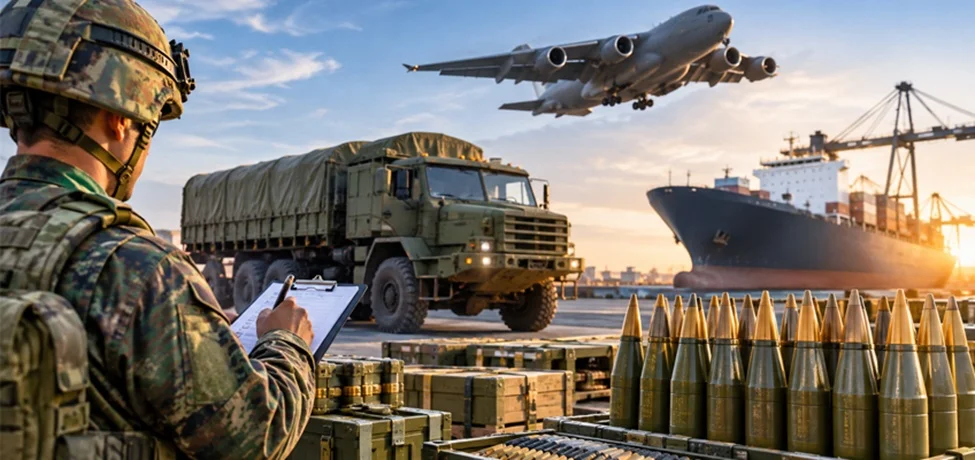
A weapon is only as useful as the ammunition behind it. You can buy the best systems money can offer, but if the rounds are late, short or out of spec, those systems sit idle. That uncomfortable truth is why the arms and ammunition supply chain has moved from a quiet back-office function to a front-line readiness issue.
For defence buyers, the gap between the day a unit needs ammunition and the day it actually arrives is where the supply chain either proves itself or falls apart. Understanding that gap is now a core part of procurement.
This guide breaks down how the defence arms supply chain really works, where procurement teams get caught out, and which sourcing strategies hold up under pressure.
What Is the Arms and Ammunition Supply Chain? (Quick Answer)
The arms and ammunition supply chain is the end-to-end network that moves weapons, munitions and their components from raw materials and manufacturing, through testing, certification, storage and transport, to the end user in the field. It includes manufacturers, sub-suppliers, regulators, freight and logistics providers, and the armed forces that consume the product.
In short: it is everything that has to go right between a purchase order and a round being fired.
Why the Defence Supply Chain Is Different from Any Other
A civilian buyer can switch suppliers over a weekend. A defence buyer cannot. Several features make the defence supply chain unusually hard to manage:
- Regulation is heavy. Export licences, end-user certificates and national security reviews can add months to any deal.
- Qualification takes time. Ammunition must be tested and approved against strict specifications before it is accepted. A new supplier cannot simply be switched on.
- Specialized inputs. Propellants, energetic materials, primers and fuzes come from a narrow pool of producers, sometimes only one or two worldwide.
- Safety rules shape everything. Explosives require licensed storage, specific transport classes and trained handlers at every step.
- Demand is lumpy. Peacetime consumption is steady and predictable. Crisis demand is neither.
These realities mean that routine ideas from commercial logistics, such as just-in-time delivery, can be dangerous when applied without adaptation.
The Main Stages of Military Logistics for Ammunition
Understanding each stage helps buyers spot where risk hides.
1. Requirement and planning
Everything starts with the user need: calibre, quantity, performance, shelf life and delivery schedule. Vague requirements here create expensive problems later. A specification that is too narrow shrinks the supplier pool. One that is too loose invites poor quality.
2. Sourcing and supplier selection
This is where arms procurement and ammunition sourcing decisions are made: domestic production, licensed production, or import. Each route carries different cost, speed and dependency trade-offs.
3. Manufacturing and component flow
Ammunition is assembled from many parts: cases, projectiles, propellant, primers, fuzes. A shortage of any single component stops the whole line, regardless of how healthy the rest of the chain looks.
4. Testing and certification
Lot acceptance testing confirms that what was built meets the contract. Skipping or rushing it is a false economy, since defective ammunition costs far more than the delay.
5. Storage and transport
Ammunition has a shelf life and is sensitive to heat, humidity and handling. Storage conditions and surveillance programmes directly affect how long stock stays usable.
6. Distribution to the user
The last mile is often the hardest. Getting stock to the right unit, at the right place, in the right condition, is classic military logistics, and it is where otherwise sound plans most often fail.
Where Defence Procurement Management Commonly Goes Wrong
Experienced buyers tend to repeat the same warnings. Here are the failure points that appear again and again.
Single-source dependency. Relying on one supplier, or one country, for a critical item is efficient until it is not. A single disruption can halt supply entirely.
Ignoring sub-tier suppliers. Buyers often vet the prime contractor carefully but never look at who supplies the primer, the propellant or the steel. The weakest link is usually one level down.
Optimizing for price alone. The lowest bid can hide poor delivery performance, weak quality control or thin financial strength. Total cost of ownership matters more than unit price.
Weak contract terms. Contracts that do not address delivery penalties, lot rejection, technical data rights or obsolescence leave the buyer exposed.
Underestimating lead times. Production slots, raw material availability and licensing approvals all take longer than brochures suggest. Plans built on optimistic timelines break first.
Poor inventory visibility. If you do not know exactly what you hold, its age and its condition, you cannot plan replenishment sensibly.
Ammunition Sourcing and Procurement Strategies That Actually Work
There is no single perfect model, but the strategies below appear consistently in well-run defence procurement programmes.
Diversify your supplier base
Qualify more than one source for critical items wherever feasible. This costs more upfront, but it buys resilience. Even a smaller secondary supplier can be valuable insurance.
Build long-term supplier relationships
Multi-year contracts give manufacturers the confidence to invest in capacity, secure raw materials and keep skilled workers. Stop-start ordering does the opposite. Predictable demand is one of the most powerful tools a buyer has.
Map the supply chain down to the sub-tier
Ask suppliers to disclose their own critical sources. Knowing who makes the energetic materials and fuzes lets you spot concentration risk early.
Balance domestic capability with trusted imports
Domestic production improves security of supply but is rarely enough on its own. A mix of domestic, licensed and allied sources usually gives the best balance of speed, cost and control.
Hold strategic buffers
Safety stock for high-consumption and long-lead items absorbs shocks. The goal is not to stockpile everything, but to protect the items where a stock-out would hurt most.
Plan for the full life cycle
Think beyond delivery: storage, surveillance testing, refurbishment, demilitarisation and disposal. Buyers who plan the whole life cycle avoid unpleasant surprises years later.
Use data, not instinct
Demand forecasting, consumption analytics and supplier performance scorecards turn defence supply chain management from reactive firefighting into planned action.
A Practical Checklist for Selecting Military Ammunition Suppliers
When evaluating military ammunition suppliers, a structured review saves time and regret. Consider:
1. Regulatory standing: valid licences, export approvals and compliance history.
2. Quality systems: certifications, test records and defect rates.
3. Production capacity: can they deliver at your volume, and surge if needed?
4. Supply chain depth: where do their critical inputs come from?
5. Financial health: will they still be around for the life of the contract?
6. Delivery track record: on-time performance on comparable orders.
7. Technical support: training, documentation and after-sales service.
8. Ethics and integrity: transparent dealings and strong anti-corruption controls.
A supplier that scores well on all eight is worth a premium. One that scores poorly on any of the first three is a risk regardless of price.
Risks Defence Buyers Should Plan For
- The arms supply chain is exposed to a wide range of pressures. Good planning treats them as likely, not hypothetical.
- Geopolitical shifts: sanctions, export restrictions or changing alliances can cut off a source overnight.
- Raw material volatility: shortages or price spikes in key materials ripple down the chain.
- Capacity constraints: when many buyers need the same product at once, production slots become scarce.
- Cyber threats: supplier networks and logistics systems are targets, and a breach can expose sensitive data or disrupt operations.
- Workforce limits: skilled labour in energetics and munitions manufacturing is hard to replace quickly.
- Counterfeit and non-conforming goods: rare, but serious when they occur. Traceability and trusted channels are the defence.
Building Resilience: A Mindset Shift for Defence Buyers
Many procurement teams were trained to cut cost and cut inventory. That mindset served well in stable periods. The more useful question today is different: how quickly can we recover when something breaks?
Resilient defence supply chain management comes down to a few habits:
- Know your dependencies before a crisis exposes them.
- Keep more than one option open for anything critical.
- Invest in relationships, not just transactions.
- Review the chain regularly, not only when something fails.
- Practise the response through exercises and scenario planning.
None of this is glamorous. All of it makes the difference between a plan that looks good on paper and one that works when it is needed.
Frequently Asked Questions
What is the arms and ammunition supply chain?
It is the complete network that produces, tests, stores, transports and delivers weapons and ammunition to armed forces, from raw materials to the end user.
Why is ammunition sourcing so difficult for defence buyers?
Because suppliers must be qualified and licensed, critical inputs come from a limited pool of producers, and regulation affects every transfer and shipment.
What is the difference between arms procurement and ammunition supply?
Arms procurement usually covers the acquisition of weapon systems, while ammunition supply covers the continuing flow of munitions those systems consume. Ammunition needs ongoing replenishment, which makes it a long-term supply challenge.
How can defence buyers reduce supply chain risk?
By diversifying suppliers, mapping sub-tier dependencies, signing longer-term contracts, holding strategic buffers and monitoring supplier performance with real data.
What should be included in a defence procurement contract for ammunition?
Clear specifications, delivery schedules and penalties, lot acceptance and rejection terms, quality requirements, data rights, and provisions for storage life and obsolescence.
How long does military ammunition procurement take?
It varies widely by item, supplier and licensing requirements, and can run from months to several years. Early planning is the best protection against delay.
Final Thoughts
The arms and ammunition supply chain rewards patience, foresight and honesty about risk. The buyers who do well are rarely the ones chasing the lowest price. They are the ones who understand their suppliers, plan for disruption and treat logistics as a strategic capability.
If you are responsible for arms and ammunition procurement for defence buyers, start with three simple steps: map your critical dependencies, qualify a second source where you can, and review your contracts for gaps. Small, steady improvements here add up to real readiness.
 Our Services
 Media Pack Download
 Newsletters
 Industrial Events