

Anti-Mine and Anti-IED Technology Enhancing Protection for Modern Armored Vehicles
The Evolving Explosive Threat Landscape in Modern Warfare
The war fronts in the modern world are no longer characterized by the wars between tanks only. Asymmetric warfare has reinvented the way war is fought and explosive intimidations like landmines and improvised explosions have become a thorn in the flesh and a lethal menace. Initially created to resist the fire of ball ammunition, armored vehicles should now resist the threats of the unknown, unpredictable, and highly adaptive explosives. This has increased the significance of the use of anti-mine technology on armored vehicles and modernized anti-IED systems on the military vehicles as fundamental measures to vehicle survival and not an extra service.
IEDs and buried mine are designed to take advantage of the fact that the undercarriage and the area around vehicles are weakened so that the wheels, tracks and underbellies, which are traditionally the weakest areas of armor, fall prey. These attacks are being increasingly coupled with remote explosions, sensor-fired traps and decoy, which is rapidly leading vehicle protection systems to the next stage of being more intelligent, more layered and data-driven. Consequently, the technology of anti-mine and anti-IED of modern armored vehicles has become a hotspot of materials science, electronics, artificial intelligence, and networking of the battlefield.
Understanding Anti-Mine and Anti-IED Protection Systems
Anti-mine and anti-IED protection systems represent a very wide range of technologies intended to identify, eliminate, resist, or address explosive threats either before they occur, during the occurrence, and after the occurrence. Compared to passive armor, the current IED defense systems combine proactive sensing, real time analysis, and adaptive response systems.
Anti-mine technology to armored vehicles is mainly based on the blast deflection, energy absorption, as well as structural survivability. This comprises of special hull geometry, reinforced floors, and blast-resistant seats that minimize the flow of force of explosions to occupants. Parallel to this, military vehicle anti-IED systems focus on early warning, countermeasures on an electronic level, and situational awareness to avoid detonation.
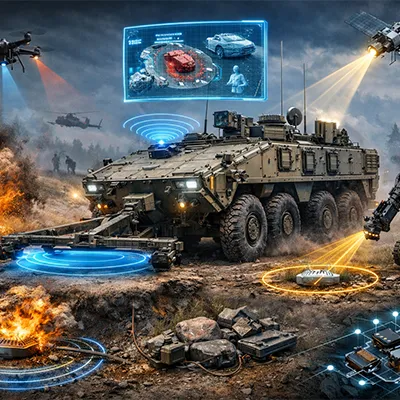
Combined, these systems create a model of a layered defense in which the mine detection systems, electronic jamming, AI-based IED detection, and physical protection operate in tandem to increase the survivability of crew and mission continuity.
Structural Engineering Innovations in Anti-Mine Protection
Among the most obvious developments in the area of anti-mine technology against armored vehicles, vehicle architecture development deserves to be mentioned. V-shaped and double-V hull structures have since become common on several contemporary platforms and have diverted the blast power out of the compartment. These structural inventions are reinforced with high strength steels, composite armor and energy absorbing subframes which deform in regulated manners during an explosion.
Even suspension systems have been re-engineered to serve as sacrificials, preventing the main hull to take the impact of the blast before it gets them. Moreover, floating floors and blast seats lessen the spinal damages by lessening the vertical acceleration of the underbody explosions. Although these measures are not an anti-explosive barrier, they play a huge role in mitigating threats of explosions by minimizing fatal and life-altering injuries.
Detection First: The Role of Mine Detection Systems
The key to survivability is now becoming a question of prevention, as opposed to survival. The current mine-detecting system implemented on the armored vehicles is a combination of ground-penetrating radars, electromagnetic sensors and thermal imaging, to detect and track down concealed explosives on the ground in real time. Such systems are capable of functioning at convoy speed, and they offer continuous scanning without reducing the rate of operation.
Mine detection systems have now been closely combined with onboard mission computers and battlefield threat recognition systems. The system has the capability to notify the crew about a potential threat when detected, digitally mark the position of the threat and distribute the threat data to other vehicles in the network. This is a giant leap to collective force protection by virtue of the transition of isolated sensors to networked detection ecosystems.
Anti-IED Systems for Military Vehicles in Active Environments
The IED defense systems have to deal with very dynamic enemies who continuously uphold triggering mechanisms and deployment strategies. Military vehicle anti-IED systems deal with this problem by using electronic countermeasures, signal acquiring, and spectrum dominance. They are systems that scan the electromagnetic environment to detect suspicious transmissions that are related to remote detonation devices.
There has been a move towards software-defined architecture in anti-IED protection systems to enable quick updates to the system as new threat signatures are developed. This flexibility is necessary in the field of operation where IED designs can change within weeks or sometimes days. Such systems interfere with the communication between explosives and detonators to minimize the chance of successful attacks without the need to physically interfere with the system.
AI-Based IED Detection and Battlefield Threat Recognition Systems
Vehicle survivability is one of the areas that have been transformed by artificial intelligence. IED detection systems that operate on the principle of AI process an enormous amount of sensor data and isolate tiny anomalies that could signal explosive threats. Instead of working with preset rules, machine learning models are conditioned by past attack history, topography, and patterns of behavior.
AI-based threat recognition systems are able to match visual visuals and radar signals with electronic emissions in order to determine the extent of threats in real-time. An example of this is an irregular surface on the side of the road and an abnormal RF activity which can result in an increased threat category. These systems assist in the quicker, more knowledgeable decision-making of the crews that are under extreme stress.
Notably, AI-based IED detection minimizes false positives, which has long been a problem, and may slow down operations, and undermine faith in automated systems. With live data of operations, models keep on learning, thus becoming more accurate and reliable and they are essential elements of the contemporary anti-IED protection systems.
IoT in Vehicle Mine Protection and Networked Defense
The IoT implementation of vehicle mine protection is a move towards integrated combat systems and away to the isolated ones. The sensors throughout the vehicle will constantly measure vibration, pressure, electromagnetic fields and structural integrity. This information is handled locally and exchanged over secure networks so that explosive threats can be dealt with.
Anti-mine and anti-IED technology on the modern armored vehicles could be IoT-enabled so that fleets work as smart units. When a vehicle in the formation has a threat, other vehicles in the formation will have the opportunity to course changes, deploy counter measures or pre-emptive actions. This kind of information that became common gradually becomes a part of predictive analytics, and the commanders are able to identify the areas at risk and optimize the efforts at the missions.
Vehicle-off-car Explosive Threat Mitigation
The mitigation of the explosive threat is not only limited to the physical platform, but training, doctrine, and sustainment are also involved. It has now been advanced to simulators that bring real-life situations of mines and IED, whereby crews go through the training under the same detection and countermeasure systems utilized in the field. This familiarity enhances the reaction time and minimizes human error in the face of real world encounter.
Modular anti-IED protection systems are simpler to upgrade and maintain in terms of sustainment. New sensors or algorithms are compatible with the existing ones, they can be added without having to redesign the whole car. This modularity is particularly attractive to the defense procurement agencies that would desire to have the long-term value and lifecycle flexibility.
Industry View: Procurement, Compliance and Interoperability
In B2B perspective, the anti-mine and anti-IED systems market is preconditioned by the high level of military standards and interoperability needs and the dynamic assessment of threats. Defense OEMs and technology suppliers need to make sure that their solution fits with the current vehicle platforms, command systems, and allied forces.
Software-based, scalable procurement decisions are becoming more popular than software-only procurement systems. The governments are also focusing on interoperability whereby anti-IED systems required are required in military vehicles to be able to exchange information among multinational coalitions. It is a trend that is fostering sensor vendors, AI companies, and vehicle integrators to collaborate and remake the defense industrial ecosystem.
Questions Industry Leaders Are Asking
The primary question defense program managers often pose is whether the use of AI-based IED detection can be reliable in a competitive environment. The solution is in the hybrid systems, in which AI is used to assist human judgment, not to take its place. The other popular question is on the cost benefit ratio of advanced mine detectors systems. Though initial expenses are increased, less casualties, higher success rates in missions and loss of vehicles will provide quantifiable long term returns.
Future-proofing is also an issue that is asked of the suppliers. Anti-mine and anti-IED protection systems with open architectures are the most plausible ones because they allow them to constantly upgrade in line with the changes in threats.
Frequently Asked Operational Considerations
Military operators would usually want to know the performance of these systems on urban and rural terrain. Current systems of threat recognition in battle fields are becoming terrain-blind, and sensor fusion implementation strategies adjust to the environmental conditions. Electromagnetic interference is also another issue especially in crowded electronic warfare. High-end filtering and dynamic frequency control are used to ensure the system is effective even with intense jamming.
The Future of Anti-Mine and Anti-IED Technology
Anti-mine, anti-IED technology on the modern armored vehicles will further be less autonomous, predictive, and integrated in the future. The development of edge computing will enable more rapid decision-making on board and better AI models will be able to predict threats even before vehicles reach the high-risk areas. The intersection point of AI, IoT, and new materials will keep shaping the concept of vehicle protection in the current conflict.
The defense industry has to be equally dynamic as the explosive danger evolves to be even more advanced. Anti-mines on armored and anti-IED on military vehicles are no longer niches. They are the pillars to the current force protection, defining how armored fleets will survive, evolve, and dominate the battlefield of both the present and the future.
 Our Services
 Media Pack Download
 Newsletters
 Industrial Events