

Ammunition & Weapon Systems: Current Demand and Supplier Landscape
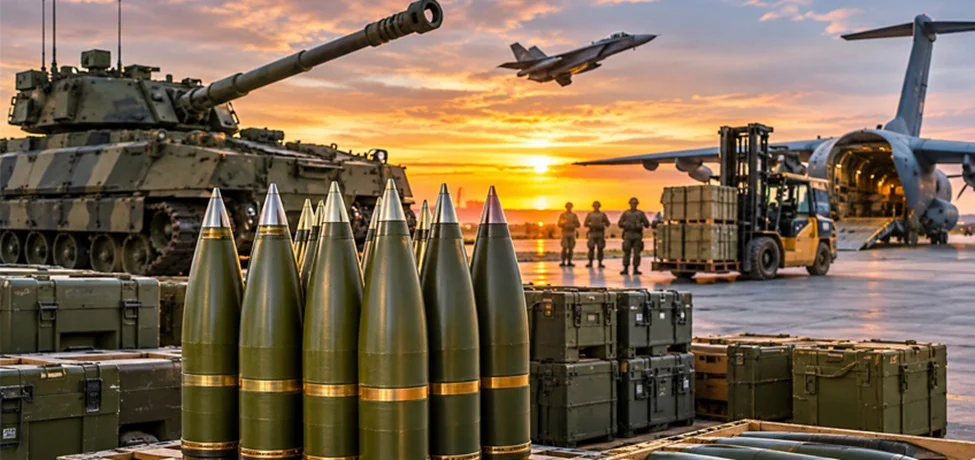
For decades, the defence conversation belonged to the spectacular: stealth fighters, aircraft carriers, hypersonic missiles. The humble artillery shell rarely made the front page. That has changed. Years of sustained conflict, drawn-down stockpiles and record budgets have forced governments to confront an uncomfortable fact: a weapon system is only as credible as the ammunition behind it.
In 2026, that reckoning is reshaping the defence ammunition and weapon systems market. Military ammunition has moved from the logistics annex to the centre of strategy, and the questions have changed with it. Who can produce at scale? Who can deliver on time? Who can be trusted when supply gets tight?
This article looks at where demand is coming from, how the supplier landscape is shifting, and which ammunition procurement trends will matter most to buyers, manufacturers and investors in the years ahead.
What is driving military ammunition demand right now?
Short answer: record defence budgets, stockpile replenishment after sustained conflicts, and a shift to long-term supply contracts.
Global military spending hit about $2.89 trillion in 2025, the 11th straight annual increase. Europe led the surge, with spending up 14 per cent to $864 billion. The US is expected to push the total higher: Congress has already approved more than $1 trillion for 2026, and the administration has proposed $1.5 trillion for 2027.
Budgets are only part of the story, though. Three forces make military ammunition demand different from past cycles.
1. Wars of attrition burn through stock. Modern conflicts consume artillery shells, air-defence interceptors and small-calibre rounds at rates peacetime planners never modelled. Replacing what has been used, or sent to partners, takes years of industrial output.
2. Stockpile targets have gone up. Governments no longer ask “how much do we need for training?” They ask “how much do we need for a prolonged high-intensity fight?” That is a much bigger number.
3. Weapon systems are diversifying. Drones, loitering munitions, counter-drone systems and air defence all create fresh demand for specialised munitions, on top of traditional artillery and small arms.
The core categories of military ammunition
Before looking at suppliers, it helps to know what is actually being bought.
- Artillery ammunition: 155 mm shells, propellant charges and fuzes. This is the category in the shortage headlines.
- Small and medium-calibre ammunition: rifle, machine-gun and cannon rounds for infantry and vehicles.
- Tank and anti-armour rounds: kinetic penetrators, HEAT and guided anti-tank rounds.
- Rockets and missiles: from multiple-launch rocket systems to precision-guided and air-defence missiles.
- Loitering and unmanned munitions: a fast-growing category that blurs the line between drone and ammunition.
Each category has its own supply chain, and the weak points differ. Artillery is constrained by steel forging, explosives filling and propellant capacity. Missiles are constrained by seekers, rocket motors and electronics.
Who are the major defence ammunition suppliers?
The defence ammunition suppliers landscape has three layers: global primes, regional champions and emerging challengers.
Global primes
European and American primes dominate large-calibre production. Germany’s Rheinmetall is the clearest example of the expansion trend. It has been growing capacity since 2022 and aims to produce around 1.5 million 155 mm artillery shells per year by 2030.
Its order book shows how demand is being converted into contracts. In September 2026, an unnamed international customer ordered a low five-figure quantity of 155 mm shells, valued in the low three-digit million-euro range. Earlier in the year, Denmark awarded a seven-year framework contract worth several hundred million euros covering ammunition including 155 mm shells.
The Danish deal points to a procurement trend we will return to: governments are moving from one-off orders to multi-year commitments.
Regional and national champions
Alongside the primes, national manufacturers serve their home markets and export niches. Their advantage is proximity, security of supply and political backing. Their challenge is scale, because the biggest orders still go to those with the deepest capacity.
Emerging challengers
India is the most interesting rising supplier. Defence exports hit a record ₹38,424 crore in FY26, a 62.6% jump on the previous year. Private firms contributed 45.16 per cent of the total, and exports reached over 80 countries, with 145 exporters.
Ammunition is central to this push. Domestic manufacturing is opening to private players: more than 150 companies are currently going through licensing to make explosives and propellants. One market estimate expects the Indian ammunition market to grow from $2.66 billion in 2026 to $4.44 billion by 2031. Policy is moving the same way, with the draft Defence Acquisition Procedure 2026 raising indigenous content requirements from 50 to 60% for prioritised categories.
Five ammunition procurement trends to watch
These are the patterns separating smart buyers and suppliers from everyone else.
1. Framework contracts over spot buying
Multi-year frameworks give suppliers the certainty to invest in new lines. Buyers get priority access to output. Expect more of these, because capacity cannot be built on a single order.
2. Capacity expansion through conversion
Suppliers are not only building greenfield plants. Some are converting existing industrial sites, for example repurposing automotive component facilities to make steel projectile bodies. This is faster than starting from scratch.
3. Supply-chain depth matters as much as final assembly
The shell is only one part of the round. Propellant charges, fuzes, energetics and forgings are all potential bottlenecks. Smart buyers now audit their suppliers’ suppliers.
4. Interoperability and standardisation
Ammunition that fits a wide range of platforms is far more valuable than a proprietary round. This is why NATO-standard 155 mm production is the centre of so much investment.
5. Local production and “make in” policies
Countries want sovereign ammunition capability, and they are using procurement rules to get it. For foreign suppliers, that increasingly means licensing, joint ventures and local factories rather than pure exports.
Defence weapon systems: how ammunition shapes the wider market
The defence weapons market cannot be understood without ammunition. Every artillery piece, air-defence battery and armoured vehicle is a long-term commitment to a supply of consumables.
This changes how buyers choose military weapon systems. The platform’s performance still matters, but the questions now include:
- Can we get ammunition for this system in wartime?
- Is there more than one qualified supplier?
- What is the lead time to replenish stocks?
- Can we produce or co-produce locally?
A technically superior system with a fragile ammunition supply can be a worse buy than a slightly less capable one with deep, diversified supply.
Risks and bottlenecks
Rising budgets do not automatically turn into delivered rounds. Analysts note that higher nominal budgets do not convert into revenue if procurement cycles stay slow, export controls tighten, or purchasing is centralised in ways that squeeze contractor margins. Others point out that procurement reforms are lagging and industrial capacity is constrained in Europe.
Key risks to keep in mind:
- Lead times: new lines take years to reach full output.
- Raw materials and energetics: shortages of steel, explosives and propellant ingredients can stall production.
- Skilled labour: specialized workforces are slow to scale.
- Regulation and export controls: licensing can delay or block deals.
- Demand cliffs: if conflicts de-escalate, suppliers who over-expanded face idle capacity. Framework contracts help manage this risk.
Frequently asked questions
What is driving demand for military ammunition in 2026?
Record global defence spending, depleted stockpiles from ongoing conflicts, higher stockpile targets and new categories like drones and air defence.
Who are the biggest defence ammunition suppliers?
Large European and American primes lead in large-calibre ammunition, supported by national champions and fast-growing entrants such as India’s public and private manufacturers.
What is the most in-demand type of military ammunition?
155 mm artillery ammunition, along with air-defence interceptors and medium-calibre rounds.
How do governments buy ammunition now?
Increasingly through multi-year framework contracts, often tied to local production requirements, rather than single large purchases.
Is the defence weapons market likely to keep growing?
Spending forecasts point upward. SIPRI researchers expect the growth to likely continue through 2026 and beyond, though conversion of budgets into deliveries depends on industrial capacity.
The bottom line
The military ammunition demand and supplier landscape has moved from quiet logistics to strategic priority. Budgets are at record levels, procurement is shifting to long-term partnerships, and new suppliers are entering from outside the traditional Western core.
For buyers, the lesson is to treat ammunition supply as a design requirement, not an afterthought. For suppliers, the opportunity is real but rewards those who can prove capacity, resilience and reliable delivery. For everyone else, it is a reminder that the quiet, unglamorous side of defence industry often decides what happens on the field.
 Our Services
 Media Pack Download
 Newsletters
 Industrial Events