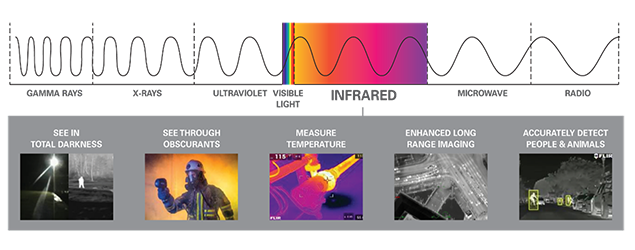

Thermal imagers make pictures from heat, also called infrared (IR) or thermal energy. They capture IR energy and use that energy to create images through digital or analog video outputs, with the details defined by differences in temperature. Heat is a separate part of the electromagnetic spectrum versus typical visible light. A camera that can detect visible light won’t see thermal energy, and vice versa.
Infrared camera detectors are made of an array of individual detector elements. Because the wavelengths of energy in the IR spectrum are longer than those of visible light, each IR detector element has to be correspondingly larger than elements on visible light detectors in order to absorb the larger wavelength. As a result, a thermal camera usually has lower resolution (fewer pixels) than a visible light sensor of the same mechanical size.
Originally developed for surveillance and military operations, thermal cameras are now widely used for industrial applications such as building inspections (e.g., moisture, insulation, roof, etc.), firefighting, autonomous vehicles, automatic emergency braking (AEB) systems, industrial inspections, scientific research, and much more. These cameras come in a variety of form factors, from handheld cameras to unmanned drones, to scientific instruments sent into outer space.
One specification that is often overlooked at the expense of resolution is thermal sensitivity. Better sensitivity makes thermal imagers more effective, but why is it important?