

Next-Generation C2 Solutions: What B2B Buyers Should Look For
Here's a scenario most defence procurement teams know too well. The demo goes beautifully. The interface is slick, the map is crisp, the vendor's engineer clicks through a mock scenario without a hitch. Then the system reaches a real exercise, the network drops to a trickle, two allied units can't share a track, and an operator spends ten minutes hunting for a function that should take ten seconds.
The brochure didn't lie. It just didn't ask the right questions. This guide will help you ask them.
Quick Answer: What Should You Look for in a Next-Generation C2 System?
The best next-generation command and control systems share six traits: open, standards-based interoperability; resilience on degraded networks; built-in cybersecurity; fast, trustworthy data fusion and decision support; an interface operators can use under stress; and a clear, affordable upgrade path. If a vendor can't prove all six in a field trial, keep looking.
The rest of this article unpacks each one, with a practical checklist you can take into your next evaluation.
What Are Next-Generation C2 Systems?
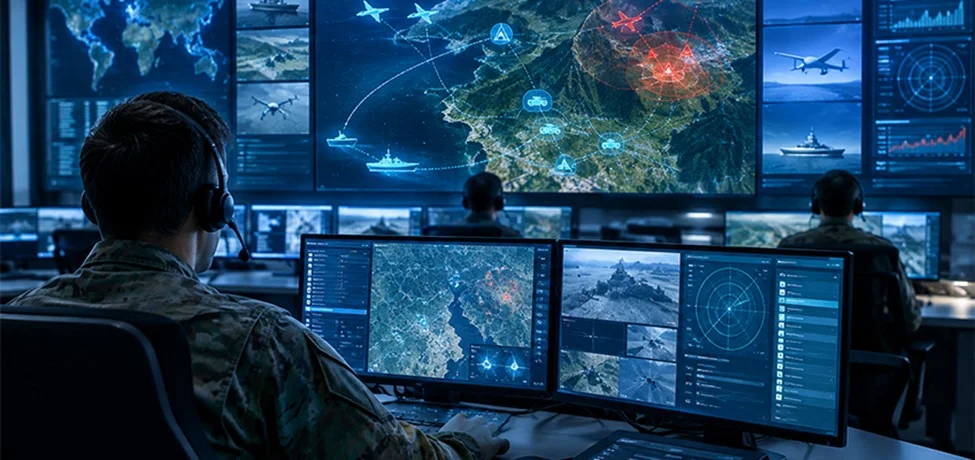
Next-generation C2 systems are software-defined command and control platforms that collect data from many sources, build a shared operating picture, and help commanders decide and act faster, across land, air, sea, space and cyber domains.
Traditional command and control systems were built as closed, single-service tools: one vendor, one network, one set of proprietary formats. They did their job in a world of predictable, linear operations.
That world is gone. Modern operations are joint, multinational and data-heavy. Drones, sensors, satellites and soldiers all generate information, and the advantage goes to the side that can turn that flood into a decision first. Next-generation military C2 solutions are designed around that reality, with modular software, open interfaces and decision-support tools at the core.
Why Legacy Systems Are Holding Programs Back
Before looking at criteria, it helps to understand what you're moving away from. Legacy defence C2 systems tend to share the same weaknesses:
- Data silos. Each platform speaks its own language, so sharing information means manual workarounds.
- Slow upgrades. Adding a capability can take years because everything is tightly coupled.
- Network dependence. Many assume constant, high-bandwidth connectivity that real battlefields rarely provide.
- Vendor lock-in. Proprietary architecture makes you pay, repeatedly, for the right to change.
If your current setup has two or more of these, you're already paying a hidden tax in speed, money and risk.
9 Command and Control System Selection Criteria That Actually Matter
1. Open architecture and interoperability
This is the big one. Ask which standards the system supports and how it exchanges data with allied and legacy systems. A truly integrated defence C2 system should plug into existing sensors, effectors and coalition networks without custom-built bridges every time.
Ask the vendor: "Can you show live data exchange with a third-party system, not a slide about it?"
2. Resilience in contested, degraded environments
Your network will be jammed, congested or cut. The question is what happens next. Look for systems that keep working at the tactical edge with low bandwidth, intermittent links or none at all, then sync cleanly when connectivity returns. Military command and control solutions that fall over when the link does are a liability, not a tool.
3. Cybersecurity built in, not bolted on
A C2 system is a high-value target by definition. Prioritise zero-trust principles, strong encryption, role-based access, full audit trails and a vendor with a transparent vulnerability-management process. Ask about accreditation and how quickly security patches reach fielded systems.
4. Data fusion and decision support
Raw data isn't intelligence. Good systems fuse feeds from many sources into a single, deduplicated, trustworthy picture, and increasingly use AI-assisted analytics to flag threats, suggest courses of action and cut operator workload.
One caution: insist on explainability. If a recommendation can't be traced back to its inputs, commanders will rightly distrust it.
5. Operator experience and usability
Systems get used in the dark, in the cold, by exhausted people. Clean layouts, minimal clicks, role-based views and short training curves matter far more than feature count. Ask to put your own operators, not the vendor's, in front of the interface during evaluation.
6. Scalability across echelons
Can the same architecture support a single vehicle, a battalion headquarters and a joint operations centre? Scalable battlefield management systems let you grow without rebuilding, and keep everyone working from the same picture.
7. Sovereignty, compliance and local support
For many buyers, this decides the shortlist. Check data-residency options, export-control implications, certification status, and whether the vendor offers local engineering support, training and, where relevant, industrial participation. A brilliant system you can't legally modify or sustain is a stranded asset.
8. Total lifecycle cost and upgrade path
Look past the purchase price. Compare licensing models, hardware dependencies, training costs, integration fees and what upgrades will cost in year five. Modular, software-defined designs usually win here, because capabilities can be added without replacing the whole system.
9. Proven track record
Demand evidence: field trials, live exercises, operational deployments and references you can call. "Roadmap" features are promises. Fielded capability is proof.
C2 vs. Battlefield Management Systems: What's the Difference?
Buyers often confuse the two, and vendors don't always help.
Battlefield management systems (BMS) are typically tactical, giving units at the lowest levels a shared picture of friendly forces, enemy positions and orders. Command and control systems span the wider chain, from tactical to operational and strategic, covering planning, coordination and decision-making across the force.
In practice, the best programs treat BMS as the tactical layer of a broader C2 architecture. If a vendor can't explain how their BMS feeds higher echelons, that's a gap worth probing.
Legacy vs. Next-Generation C2 at a Glance
|
Factor |
Legacy C2 |
Next-Generation C2 |
|
Architecture |
Closed, proprietary |
Open, modular |
|
Data sharing |
Siloed |
Shared, multi-domain |
|
Network needs |
Stable, high bandwidth |
Works in degraded conditions |
|
Upgrades |
Slow, costly |
Continuous, software-led |
|
Decision support |
Manual |
AI-assisted, explainable |
|
Security |
Perimeter-based |
Zero-trust, built in |
Red Flags to Watch for During Evaluation
- Demos that only run on perfect connectivity. Ask for a degraded-network demonstration.
- Vague answers on standards. "We're fully interoperable" means nothing without specifics.
- AI claims without explanation. If it's a black box, it's a risk.
- Pricing that hides integration costs. Get everything in writing.
- No customer references. Or only references the vendor chose carefully.
- Heavy customisation required out of the box. That's often a sign of an inflexible core.
A Simple 5-Step Process for Evaluating Vendors
1. Define operational needs first. Write requirements around missions and decisions, not features.
2. Shortlist on evidence. Use the criteria above and drop anyone who can't show fielded proof.
3. Run a realistic trial. Include degraded networks, mixed legacy equipment and your own operators.
4. Stress-test security and integration. Bring independent testers where possible.
5. Model the full lifecycle cost. Compare five- and ten-year totals, not just the quote.
Frequently Asked Questions
What is a command and control (C2) system?
A C2 system is the combination of people, processes and technology a commander uses to plan, direct and monitor operations. Modern versions are software platforms that build a shared operating picture and support faster decisions.
What makes a C2 system "next-generation"?
Open architecture, multi-domain data fusion, resilience on degraded networks, built-in cybersecurity and AI-assisted decision support. Together these separate it from older, closed and siloed systems.
How do I choose a defence C2 system?
Start with your mission requirements, then assess vendors on interoperability, resilience, security, usability, scalability, sovereignty, lifecycle cost and proven field performance.
What is the difference between C2 and C4ISR?
C4ISR extends command and control with communications, computers, intelligence, surveillance and reconnaissance. C2 is the decision-making core; C4ISR describes the wider ecosystem that feeds and supports it.
How long does C2 implementation take?
It varies widely by scope, from months for a modular tactical deployment to several years for a force-wide programme. Modular, software-defined systems generally shorten timelines because they can be fielded in stages.
Final Thoughts
Choosing command and control technology for defence is one of the highest-stakes purchases an organisation can make, because the system shapes every decision made through it. The strongest buyers don't chase the longest feature list. They ask harder questions, run realistic trials and insist on proof.
Use the criteria above as your scorecard. If a next-generation C2 solution holds up on interoperability, resilience, security, usability and lifecycle value, you've likely found a partner worth building with.
Evaluating C2 options right now?
Start by writing down your three toughest operational scenarios, then ask every vendor to show you how their system handles them live. The answers will tell you far more than any brochure.
 Our Services
 Media Pack Download
 Newsletters
 Industrial Events