

Seeing Beyond the Visible: How the FXO SWIR Camera Is Redefining Defence and Security Imaging
There's a moment every imaging engineer knows well - staring at a scene that looks perfectly clear to the naked eye, yet completely fails to reveal what a sensor actually needs to see. Fog, smoke, camouflage, glare, darkness - these are the everyday enemies of surveillance and inspection systems. For decades, the answer to "see through it anyway" has involved bulky, expensive, power-hungry hardware that simply wasn't practical outside a lab. That's changing. The new FXO series, and in particular its SWIR variant, is proof that high-performance imaging no longer has to come wrapped in compromise.
A Camera Built Around a Simple Idea: Do More With Less
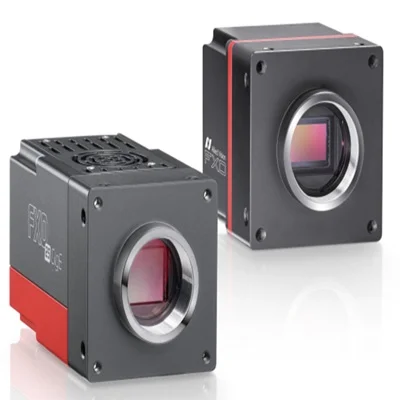
The FXO series was designed around a straightforward but ambitious goal - combine the image quality of Sony's Pregius S sensor family with the fastest interfaces available in machine vision today, all inside a housing small enough to fit where other cameras simply can't. With support for 10GigE, 25GigE, 100GigE, and CoaXPress-12, the FXO gives integrators a genuine choice of interface without forcing a trade-off in image fidelity. It's the smallest camera on the market offering a CXP12-2C (2-connection) interface, and its thermally optimized, precision-milled housing keeps sensor performance stable even under sustained operation.
For general industrial and scientific applications, that's already a compelling proposition. But it's the SWIR variant of the FXO - built on Sony's SenSWIR sensor technology - that opens the door to a much more demanding and consequential category of use: defence and security imaging.
Why SWIR Matters for Defence and Security
A standard visible-light SWIR camera doesn't just extend the wavelengths a system can detect - it fundamentally changes what a camera can "see" in the first place. Short-wave infrared imaging, spanning roughly 400 nm to 1700 nm in the FXO SWIR's case, penetrates atmospheric conditions that defeat conventional optics. Haze, smoke, light fog, and even certain camouflage materials that are designed to fool visible-spectrum cameras become far less effective against SWIR sensing. This is precisely why SWIR imaging for defence and security has moved from a niche research tool to a mainstream requirement across military and homeland security procurement programs.
The FXO SWIR camera brings this capability into a compact, industrially hardened package. Built on the same robust FXO platform used across the broader product line, it pairs the sensitivity of the SenSWIR sensor with a sophisticated thermal design that maintains excellent image quality and a wide dynamic range even in demanding field conditions - a critical requirement for any camera destined for outdoor, mobile, or unattended defence deployment.
Defence Imaging Systems Need More Than Just Sensitivity
Designing defence imaging systems is never just about picking the most sensitive sensor available. Reliability, environmental tolerance, data throughput, and system integration all matter just as much as raw image quality. This is where the FXO SWIR earns its place.
Consider the operating temperature range: the camera is rated to function reliably up to 60 °C, a specification that matters enormously when a unit is mounted on a vehicle roof in a desert theatre, inside a sealed enclosure on a perimeter tower, or on an unmanned platform with limited passive cooling. Add to that industrial TTL-24V I/O, SafeTrigger functionality, programmable logic sequencers and timers, and an RS-232 interface, and you have a camera that speaks the language defence system integrators already use - not a lab instrument that needs to be adapted for the field.
On the data side, the FXO SWIR supports both CoaXPress-12 for minimal-latency, maximum-throughput applications and 10GigE for teams that need cost-effective bandwidth without the complexity of specialized frame grabbers. That flexibility matters enormously in defence surveillance cameras, where system architects are frequently balancing procurement budgets against mission-critical performance requirements.
Where SWIR Earns Its Keep: Real Applications
It's worth walking through where this technology actually gets deployed, because the phrase "SWIR camera" can sound abstract until you see it in context.
Low-light and night operations. One of the most valuable properties of short-wave infrared is its ability to work with ambient night sky radiance - the natural SWIR emission present even on moonless nights - without the need for active illumination that could reveal a unit's position. This makes low-light imaging for defence one of the most active SWIR use cases today, particularly for covert observation posts and passive night surveillance where emitting your own light source isn't an option.
Perimeter and border monitoring. Long-range detection through atmospheric haze is a defining strength of SWIR. Border surveillance cameras built around this technology can maintain image clarity across kilometres of open terrain where visible-spectrum systems lose contrast to atmospheric scattering. Combined with the FXO's high resolution - up to 24.6 megapixels in the broader FXO family - operators get both the range and the pixel density needed to identify, not just detect, activity at a distance. This is a core reason SWIR cameras for border security have become a standard line item in modernization programs for agencies responsible for large, remote frontier zones.
Airborne and drone-mounted reconnaissance. Weight, power draw, and housing size are unforgiving constraints on any airborne platform. The FXO's compact, thermally optimized housing and efficient interface options make it a realistic candidate for integration onto unmanned platforms, and the growing interest in SWIR cameras for drones reflects how valuable it is to combine aerial mobility with atmospheric-penetrating imaging. A drone that can identify a target through haze or light foliage cover, at any time of day, delivers a fundamentally different level of situational awareness than one limited to visible light alone.
Fast-moving target tracking. Interfaces like CoaXPress-12 and 25/100GigE aren't just about pushing more pixels - they're about capturing motion without smear or dropped frames. High-speed imaging for defence applications, from projectile tracking to fast-moving vehicle identification, depends on sustaining high frame rates without sacrificing resolution or dynamic range, and the FXO's interface flexibility gives system designers room to scale as mission requirements grow.
The Sensor behind the Capability
None of this works without a genuinely capable image sensor at the core, and this is where the Sony SenSWIR technology inside the FXO SWIR does the heavy lifting. It delivers high quantum efficiency across its spectral range, meaning more of the available light is actually converted into usable signal rather than lost - a critical factor in any low-light or long-range scenario. The camera also incorporates advanced two-point Non-Uniformity Correction (NUC), which compensates for the pixel-to-pixel response variations that are inherent to SWIR sensor arrays. Without this correction, SWIR images can suffer from fixed-pattern noise that degrades both visual clarity and downstream analytics accuracy - a problem the FXO SWIR addresses at the hardware and firmware level.
The broader FXO platform contributes its own set of advantages here too: the integrated 4-channel strobe controller supports advanced, synchronized inspection and detection tasks, useful in scenarios where illumination timing needs to be precisely coordinated with capture. Versatile image processing tools - LUT mapping, binning, region of interest selection, and burst mode - give integrators fine control over how raw sensor data is shaped into actionable imagery, whether that's for a human analyst or an automated detection algorithm.
Built to Integrate, Not Just to Perform
A camera's value in a defence context is only as good as how easily it fits into an existing system architecture. The FXO SWIR is fully GenICam and GenTL compliant, with an SDK available across Windows, Linux (x86 and ARM), and macOS - meaning integration teams aren't locked into a single ecosystem. Combined with logical trigger functions, programmable sequencers, and both electrical and optical I/O, the camera is designed to slot into existing command-and-control or sensor-fusion pipelines rather than demanding a custom-built software stack around it.
Bringing It All Together
What makes the FXO SWIR camera notable isn't any single specification - it's the combination. A compact, thermally engineered housing. A sensor purpose-built for the demands of short-wave infrared detection. Interface options that scale from cost-efficient 10GigE to blistering CoaXPress-12 throughput. And an I/O and software ecosystem built for real-world integration rather than lab demonstration.
For defence and security programs evaluating their next generation of imaging hardware - whether for a fixed border installation, a vehicle-mounted surveillance suite, or an airborne reconnaissance platform - the calculus increasingly comes down to a single question: can the system see reliably, in the conditions that matter most, without adding unacceptable weight, power draw, or cost? The FXO SWIR camera answers that question directly, giving system designers a platform that treats atmospheric penetration, low-light sensitivity, and high-speed capture not as separate problems to solve, but as a single, integrated capability.
 Our Services
 Media Pack Download
 Newsletters
 Industrial Events